
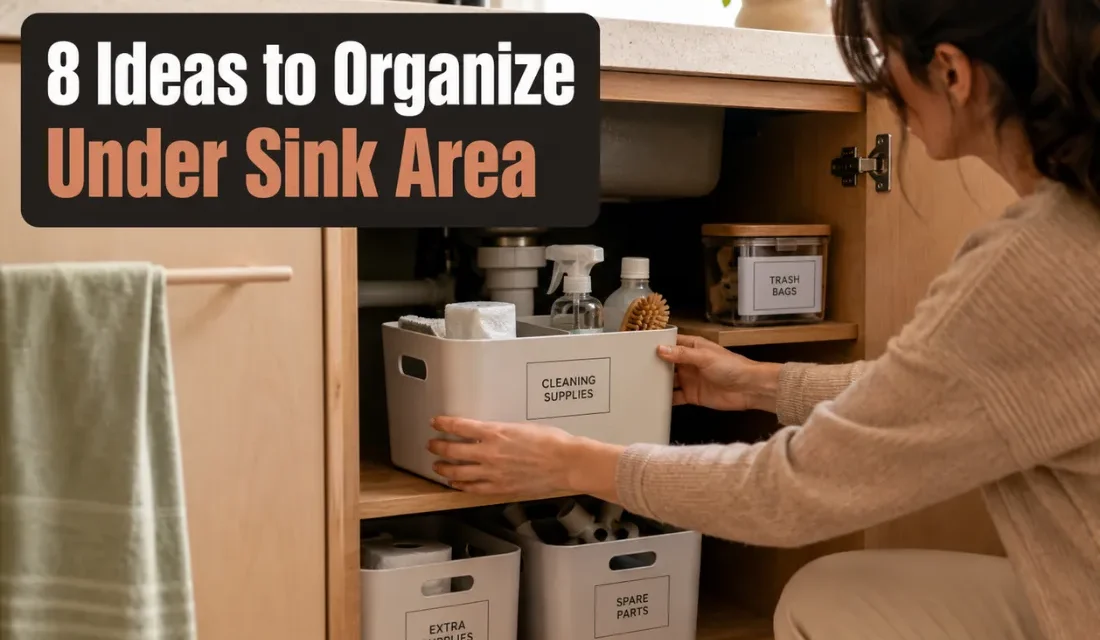
Let me be honest with you. For the longest time, I treated the cabinet under my bathroom sink like a black hole.
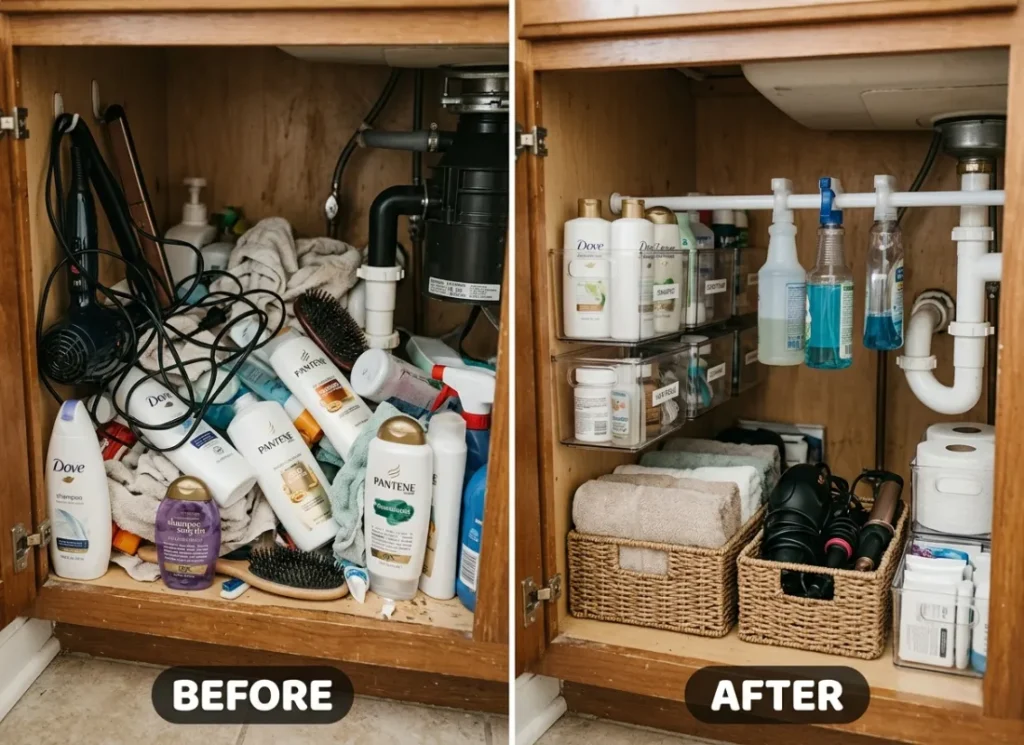
Empty shampoo bottles that I kept “just in case.” A hair dryer tangled around a curling iron. Three half-used bottles of conditioner. A cleaning spray that rolled to the back six months ago and honestly, I forgot it even existed.
Sound familiar?
With five people sharing one bathroom, that cabinet was a daily disaster. Every morning felt like a scavenger hunt. Someone needed a hair tie. Someone else needed the dry shampoo. And nobody could find anything because everything was just… piled in there together.
Then I got serious about it. And I want to tell you, the transformation did not cost a lot. I started with a tension rod and a few bins from the dollar store, and it genuinely changed how our bathroom runs every single day.
Here are the 8 under-sink storage ideas that worked for us and will absolutely work for you too.
1. The Tension Rod Trick (My Favorite and Cheapest Idea)
This one blew my mind the first time I saw it, and it became my very first step.
You take a basic tension rod, the kind you use for a curtain, and you install it horizontally inside your cabinet. No drilling, no damage, nothing permanent. It just presses against the two side walls and holds itself in place.
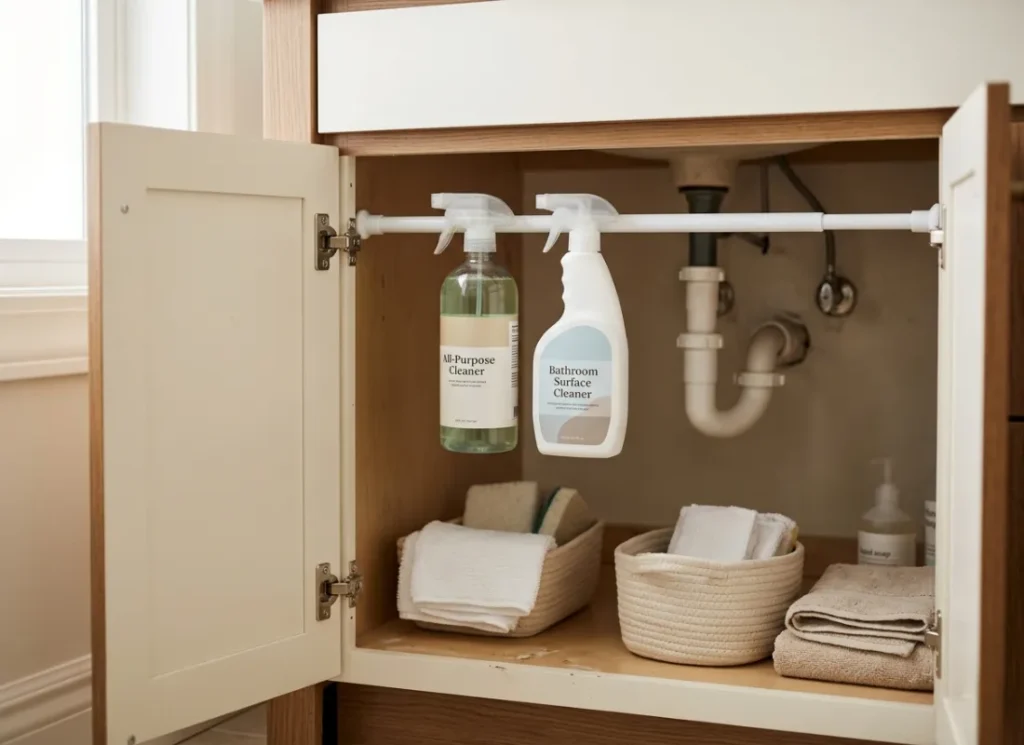
Then you hang your spray bottles on it by their trigger handles. Cleaning sprays, bathroom sprays, whatever you have. They hang in mid-air, which means the entire floor space of your cabinet is now free.
I went from a cabinet where I could not see the floor to one where I had a whole empty shelf underneath. Just from a $5 rod.
What to buy: A spring tension rod, the same ones used for small curtains or closets. Look for one that adjusts from 17 to 30 inches to fit most standard under-sink cabinets. You can find them on Amazon for around $5 to $8.
Real tip: If you have multiple spray bottles, buy two tension rods and stagger them at slightly different depths. Front rod for things you use daily, back rod for occasional-use items.
2. Dollar Store Bins for Instant Zones
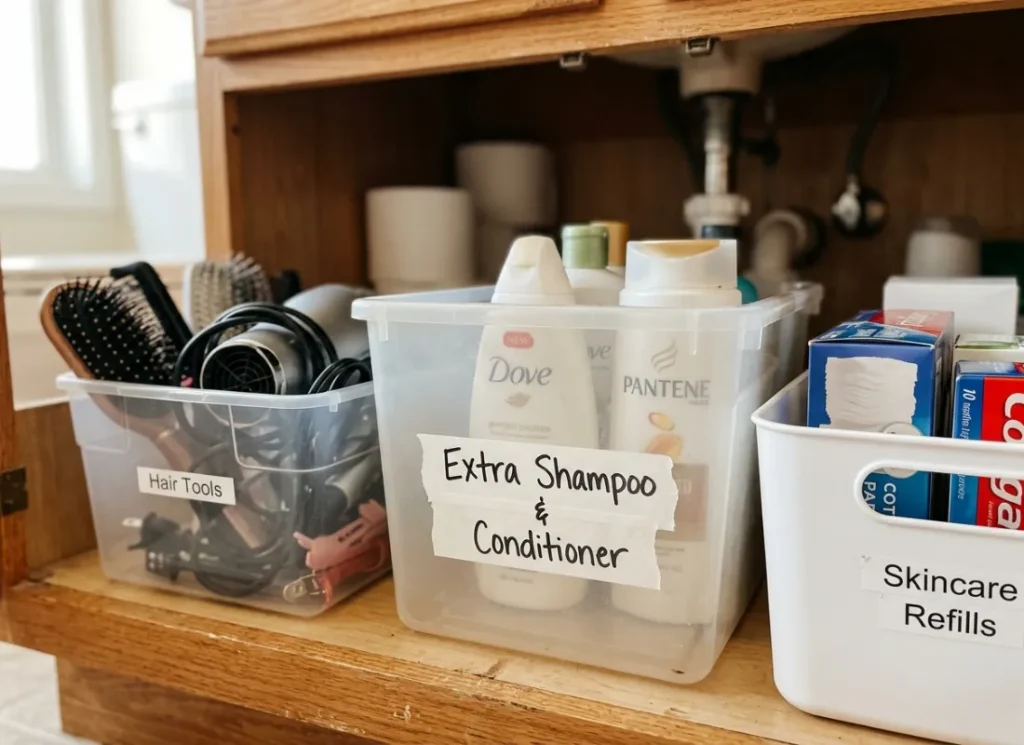
After the tension rod, the next thing I did was go to the dollar store and pick up a handful of rectangular plastic bins. Simple, cheap, totally unglamorous. Absolutely life-changing.
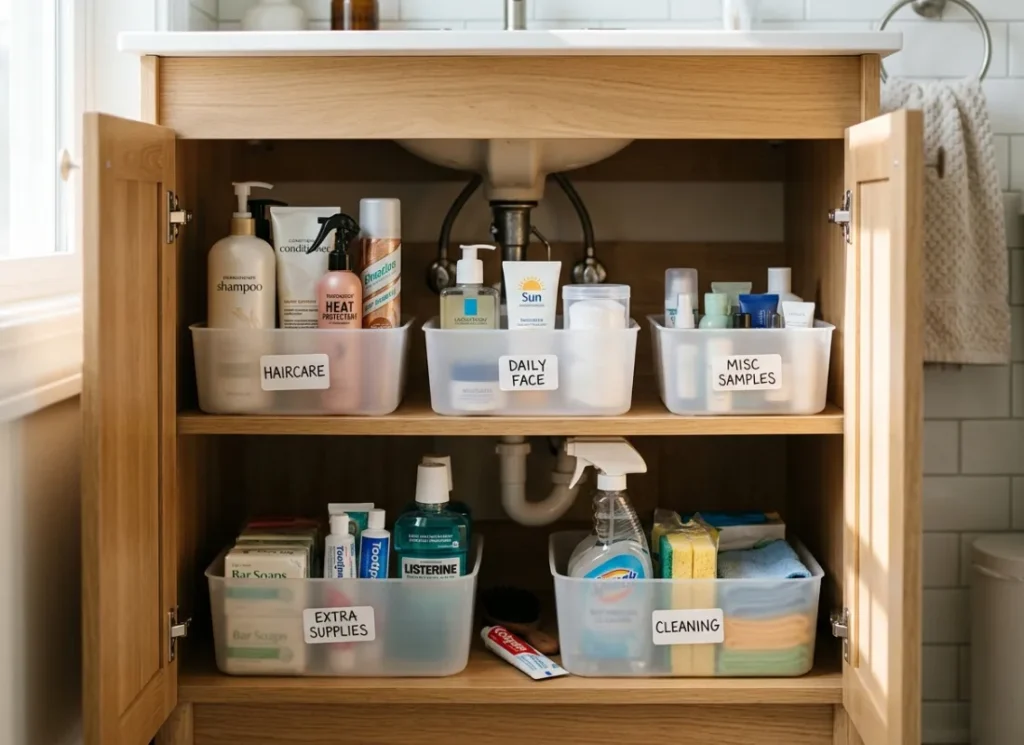
The idea is to stop letting things float loose inside the cabinet and instead group them into categories. I made three zones:
Hair tools zone: One bin holds my hair dryer, one holds styling products.
Extra toiletries zone: Backup shampoo, conditioner, soap refills all go here.
Under-the-sink essentials zone: Toilet paper backups, cleaning supplies.
When everything has a bin, even a busy household of 5 can keep things organized because everyone knows where things live. You are not organizing your stuff every week. You are just putting things back in the right bin.
Cost: Around $1 to $3 per bin at Dollar Tree or similar stores. For a full cabinet setup, you might spend $8 to $12 total.
Pro tip: Go for bins with open tops rather than lids so you can grab things quickly. Nobody has time to unsnap a lid at 7am.
3. Stackable Shelves to Double Your Space
Here is the thing nobody tells you about bathroom under-sink cabinets. You have way more vertical space than you think. Most of us just pile things on the floor of the cabinet and waste the top 8 to 10 inches completely.
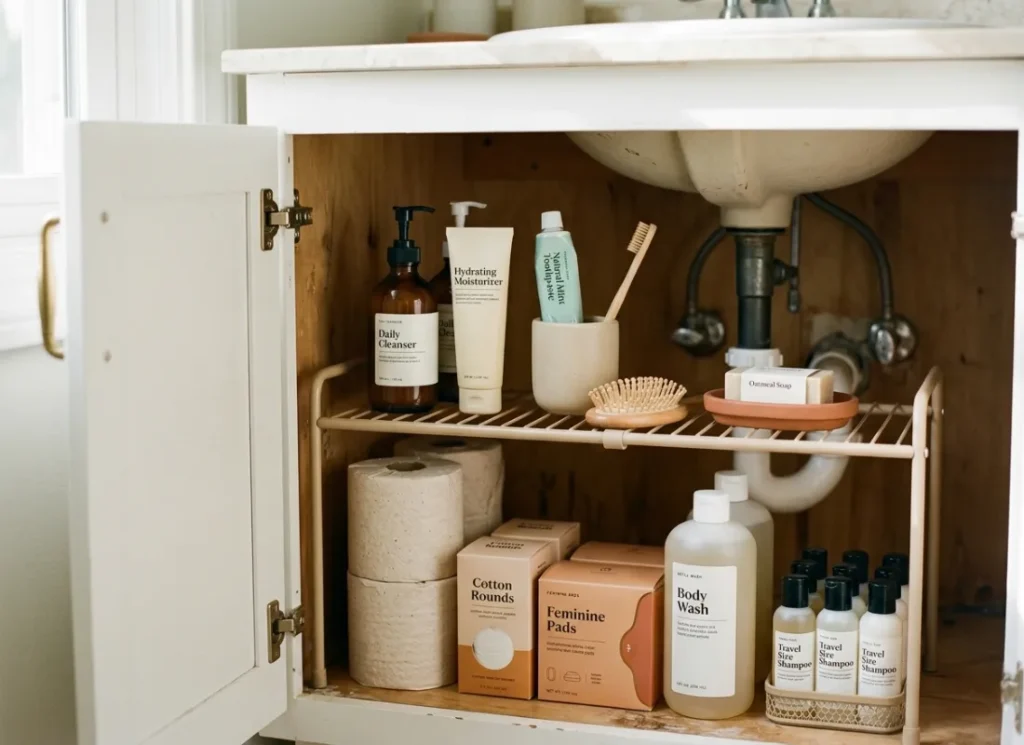
A small stackable shelf unit, sometimes called a cabinet riser or an under-sink organizer shelf, fixes this immediately. You place it inside the cabinet and suddenly you have two levels of storage instead of one.
I put my everyday items on the top level and backup or rarely used things on the floor underneath.
What to look for: A two-tier adjustable shelf designed specifically for under-sink cabinets. Most are made to work around pipes too. On Amazon, these run from $15 to $25. The Bambüsi brand and Simple Houseware brand both have solid options with good reviews.
Real tip: Measure the inside of your cabinet before you buy. Width, depth, and especially height, because some cabinets have pipes in awkward places.
4. A Lazy Susan for the Back Corner
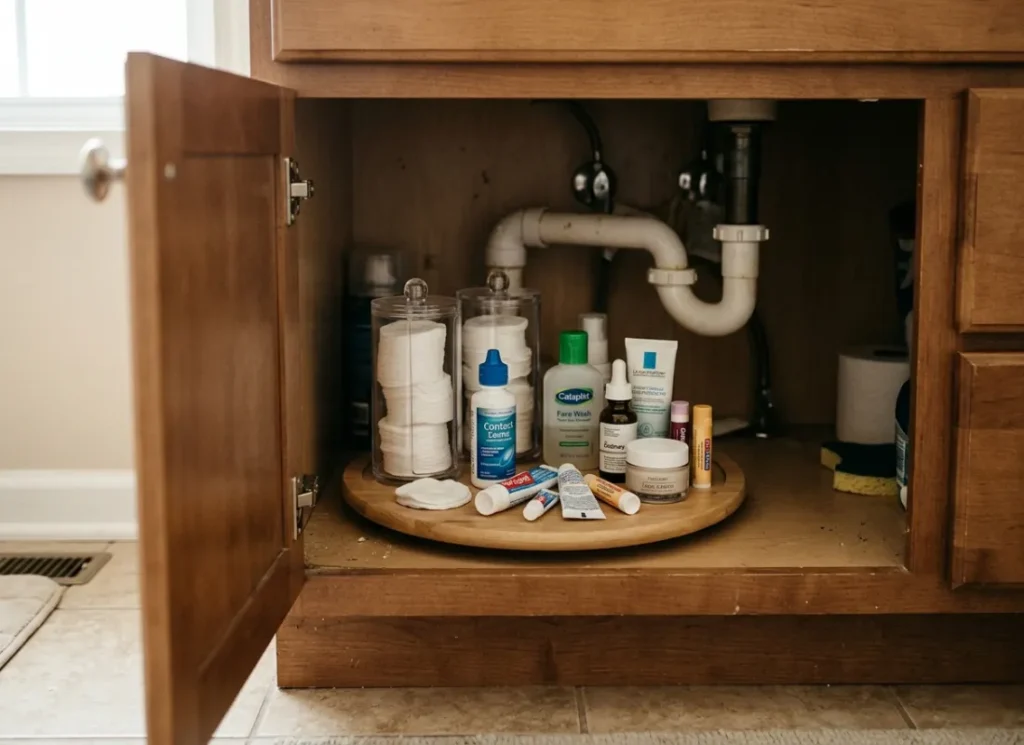
If you have ever reached into the back of your under-sink cabinet and knocked over five things trying to get to one, a lazy susan is your answer.
A lazy susan is a round rotating tray. You put it in your cabinet and spin it to reach anything instantly, even the things hiding in the back. No more shoving and fishing.
I use mine for all the smaller items that used to get lost. Nail polish remover, spare cotton rounds, a little bottle of mouthwash I keep as backup. They all sit on the turntable and I can get to any of them in one second.
Cost: A basic plastic lazy susan from Amazon costs around $8 to $15. For something that looks a little nicer, acrylic ones run $15 to $20.
Size tip: An 11-inch or 12-inch turntable fits most standard under-sink cabinets without feeling cramped.
5. Stick-On Door Organizers for Bonus Storage
The inside of your cabinet door is basically free real estate that most people never use. Your home is full of spots like this — see these wasted spaces you are not using for storage.
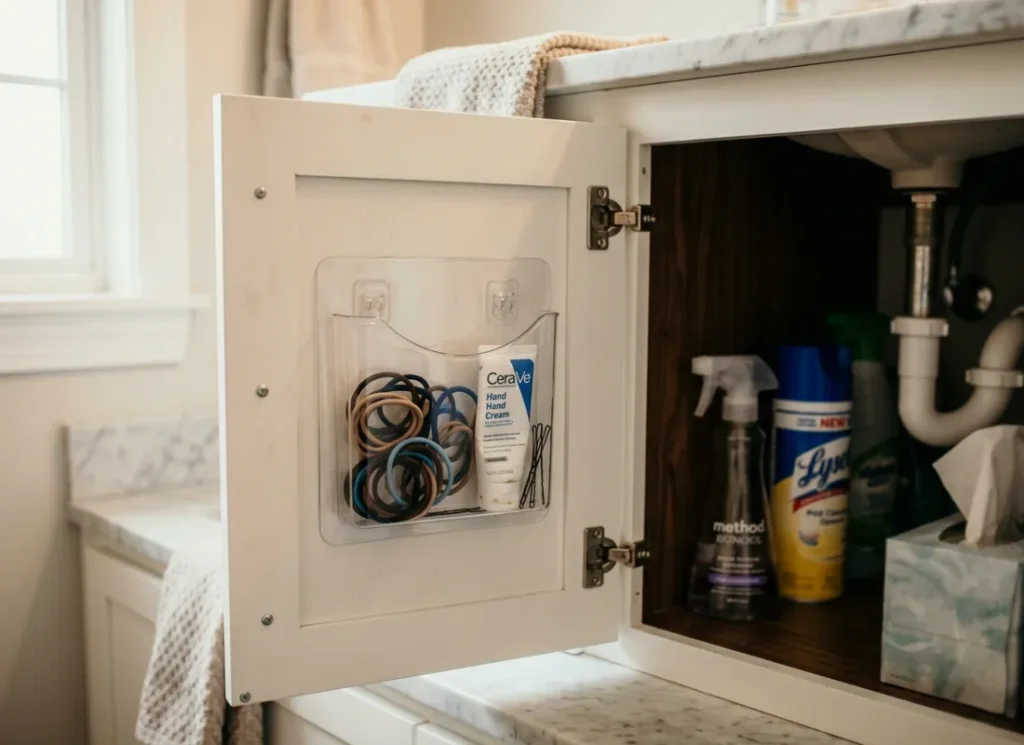
There are stick-on organizer pockets and racks made specifically for the inside of cabinet doors. No screws needed. They attach with strong adhesive strips and hold surprisingly well when installed correctly.
I use one for things I grab every single day. A small tube of toothpaste I keep as backup, a couple of hair ties, a travel-size dry shampoo. Stuff that I want close but not taking up precious shelf space.
What to buy: Look for “over the door cabinet organizer” or “adhesive cabinet door organizer” on Amazon. Prices range from $10 to $20 depending on size. Make sure the product specifically mentions adhesive mounting, not screws.
Important: Follow the installation instructions carefully, especially the waiting time before loading items. Rushing it means the strips will not hold.
6. Clear Acrylic Drawers for a Clean Look
If you want the under-sink area to feel truly pulled together, clear stackable acrylic drawers are the upgrade worth considering.
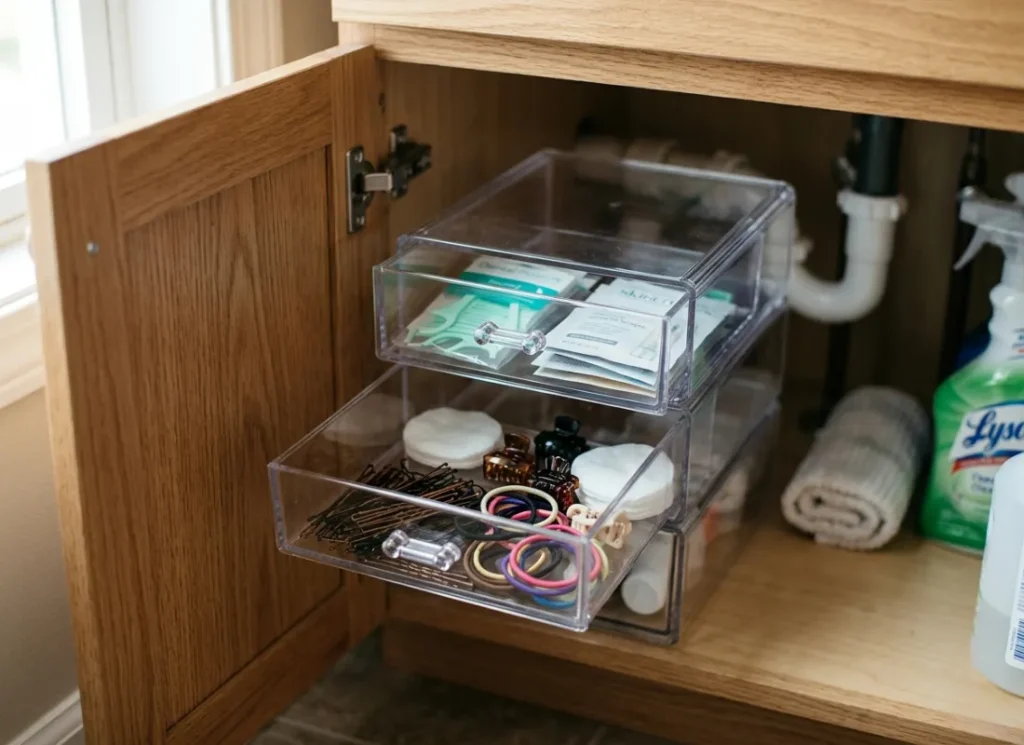
These are small drawer units, usually two or three drawers, that you stack inside the cabinet. Because they are clear, you can see exactly what is inside without opening them. This is huge when five people are moving in and out of the bathroom quickly.
I use one for hair accessories. Hair ties, bobby pins, small clips, all sorted by type in separate little drawers. It takes up less space than a bin and it looks 10 times more organized.
Cost: Acrylic drawer organizers on Amazon range from $12 to $35 depending on size and number of drawers. The SONGMICS and iDesign brands are popular and well-reviewed.
Real tip: These work especially well for small items that tend to get messy in open bins, like hair clips, cotton rounds, spare razors, or travel-size products.
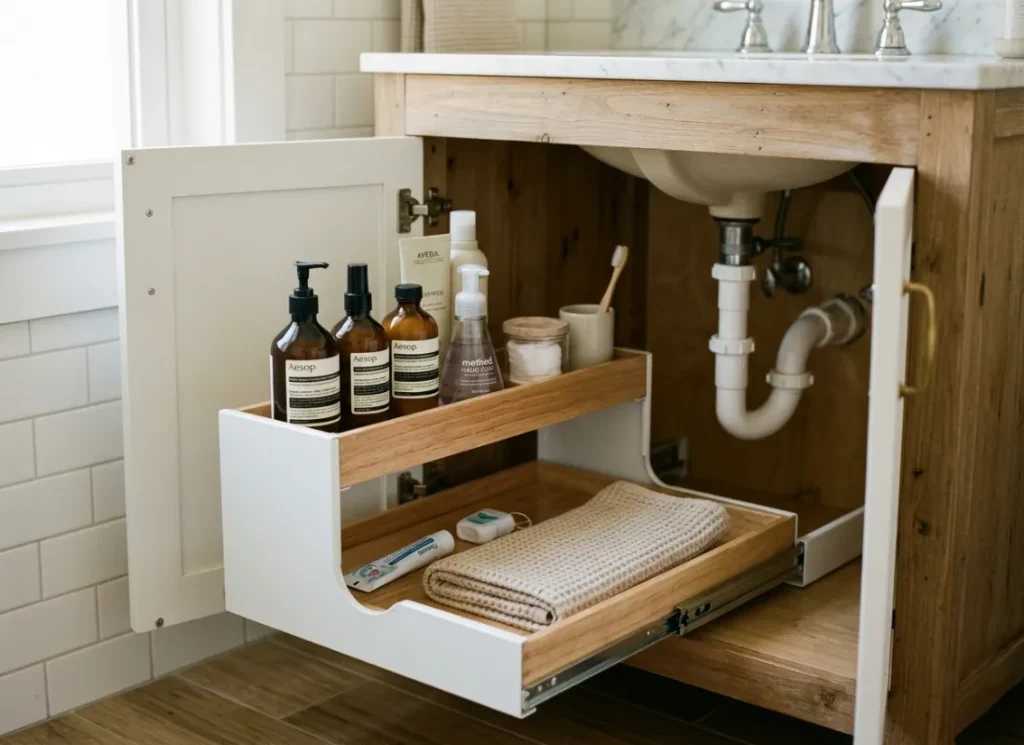
7. Pipe-Friendly Pull-Out Drawers
One of the most annoying things about under-sink cabinets is that the plumbing pipes take up the center space. Most shelves and organizers just do not account for this, and then you open the box and nothing fits.
The solution is a pull-out drawer system designed with a U-shaped cutout or split design specifically made to work around pipes.
These slide in and out like a real drawer, making it easy to access things at the back of the cabinet without digging. For a 5-person household, this kind of functionality matters every single day.
What to buy: Search for “under-sink pull-out cabinet drawer” or “under-sink organizer with pipe cutout” on Amazon. Brands like Rev-A-Shelf and AISIBO make good versions. Prices run from $20 to $45 depending on size.
Tip: Always measure your pipe placement before buying. Some organizers have the cutout on the left, some on the right, and some in the center.
8. The Label System (The Thing That Makes It Stick Long-Term)
This last idea is the one that holds everything else together.
You can have the most beautifully organized under-sink cabinet in the world, but if five people are using it with no system, it will be chaos again within two weeks. Labels are how you make organization last.
I used simple white label stickers and a black marker. Nothing fancy. Each bin and section got a label. “Hair Tools.” “Extra Shampoo.” “Cleaning.” When everyone knows where something belongs and can read the label, they actually put things back.
You can also go slightly more elevated with a label maker. The DYMO LetraTag and the Brother P-Touch are both under $25 on Amazon and give you clean, professional-looking labels that stick well on plastic and acrylic.
Real tip for shared bathrooms: If multiple people have their own products, consider labeling bins with names too. Each person in the household can have their own small bin. This eliminates the “who used my shampoo” conversation entirely.
Quick-Start Checklist
Before you buy anything, do this first:
- Clear everything out of the cabinet completely
- Toss expired products and empty bottles right away
- Measure the cabinet width, depth, and height
- Note where the pipes are and if they block center space
- Group your remaining items into categories
- Then buy organizers that fit your actual measurements
FAQ
How do I organize an under-sink cabinet with pipes in the way?
Look for organizers specifically designed with a U-shaped cutout or split design to work around pipes. Pull-out drawer systems and adjustable shelf units often come in pipe-friendly versions. Always measure your pipe location before buying.
What is the cheapest way to organize under the bathroom sink?
Start with a tension rod from a dollar store or hardware store (around $5) to hang spray bottles and free up floor space. Then add a few dollar store bins to create zones. You can organize a full cabinet for under $15 this way.
How do I organize under the sink if I share a bathroom with multiple people?
Create individual labeled bins for each person so everyone has their own dedicated space. Use a lazy susan for shared items so everything is equally accessible. Clear organizers help everyone see at a glance where things are.
Can I add storage to the inside of my cabinet door without drilling?
Yes. There are adhesive-mount door organizers that attach with strong strips and hold well without any screws or damage. Just follow the weight limits and allow proper cure time before loading them.
How often should I clean out under my bathroom sink?
Every three months is a good habit. Toss expired products, consolidate half-empty backups, and wipe down the bins. It takes about 15 minutes and keeps things from creeping back to chaos.
What should not be stored under the bathroom sink?
Avoid storing medications (heat and humidity can affect them), electronics you do not use daily, and anything that could be damaged by the occasional small leak or humidity. Keep medicines in a cool, dry place like a bedroom drawer instead.






Trackbacks/Pingbacks