
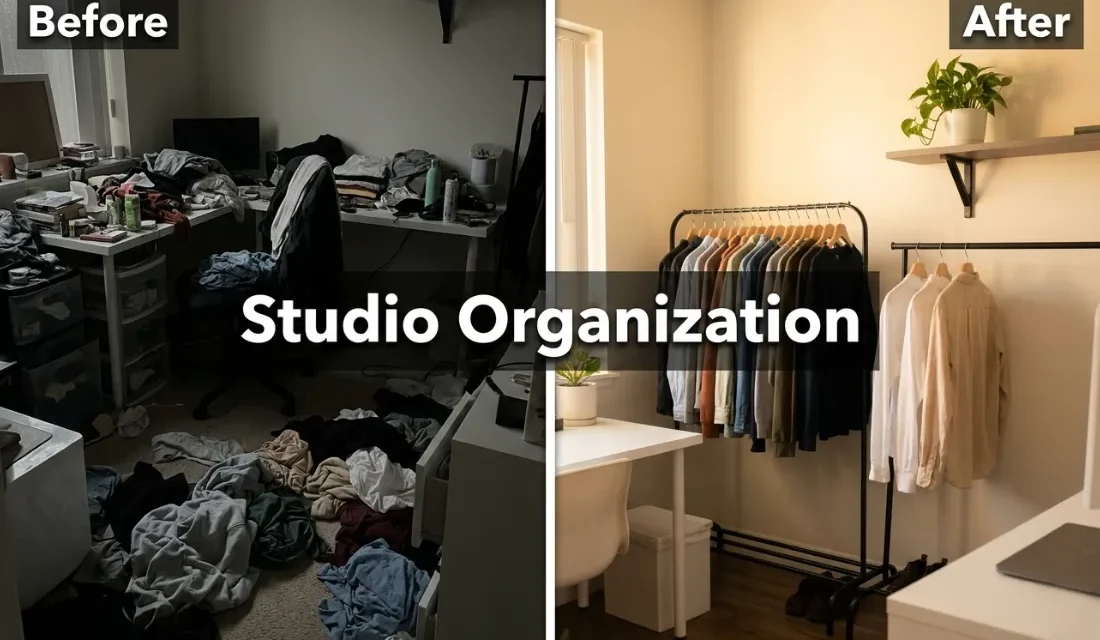
You packed everything you own into a moving truck, drove across two states, and finally got the keys to your new place. Then you walked in, looked around, and realized something: there is no closet. Not a small one. Not a half-closet. Nothing.
Just four walls, one room, and the quiet panic of wondering where exactly you are supposed to put your winter coats.
Sound familiar?
Living in a studio apartment without closet space is one of the most common challenges for young professionals, especially in cities like New York, London, Chicago, and San Francisco where rent is high and square footage is low. You are paying good money for a space that is already tight, and now you also have to figure out where to sleep, work, eat, relax, and store your entire life, all within the same four walls.
And here is the honest part: when your apartment is also your office, your bedroom, and your living room all at once, it is very easy to let things slide. You think “I live here alone, I will sort it out later” and before you know it, there is a jacket on the chair, shoes by the door, a pile of mail on the counter, and your studio starts feeling like a storage unit you happen to sleep in.
If a guest texts saying they are coming over in 20 minutes? That panic is real.
But here is what most people get wrong about small space organization: they think they need more storage. What they actually need is a better system for the storage they already have or can create with very little money.
This guide covers exactly that. Practical, low-budget ways to organize a studio apartment with no closet space, so the place you come home to actually feels like home.
(Already dealing with a tight bedroom specifically? Check out our guide on small bedroom organization ideas for more tips that work in compact spaces.)
1. Create a DIY Closet With a Clothing Rack
The most direct solution to having no closet is to build one yourself, at least visually.
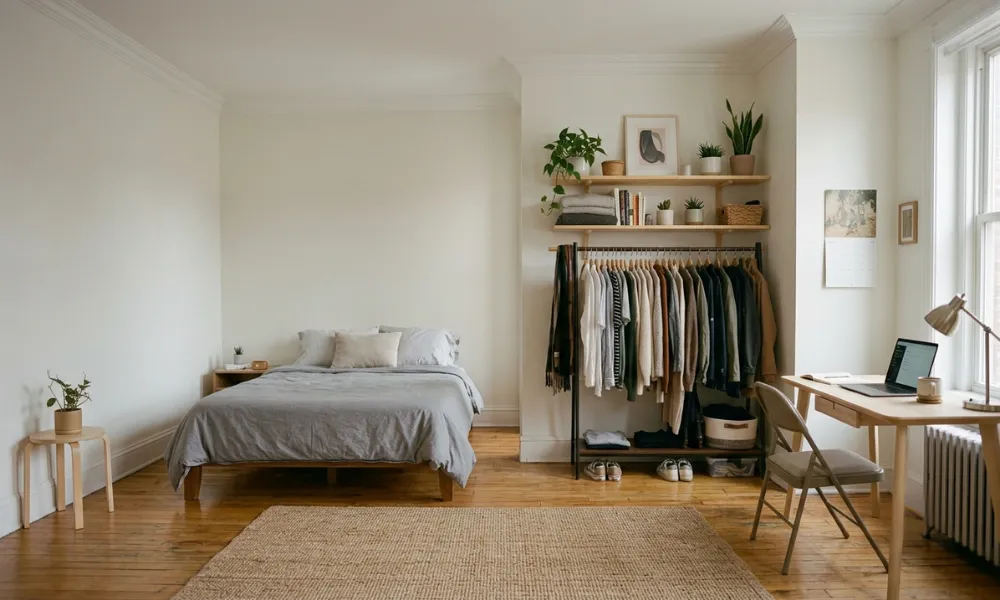
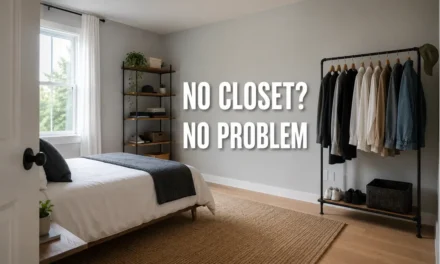
A freestanding clothing rack placed in a corner of the room does exactly what a closet rod does, without the closet. Hang your everyday clothes on it, organized by type, and suddenly you have a functional wardrobe area that takes up minimal floor space.
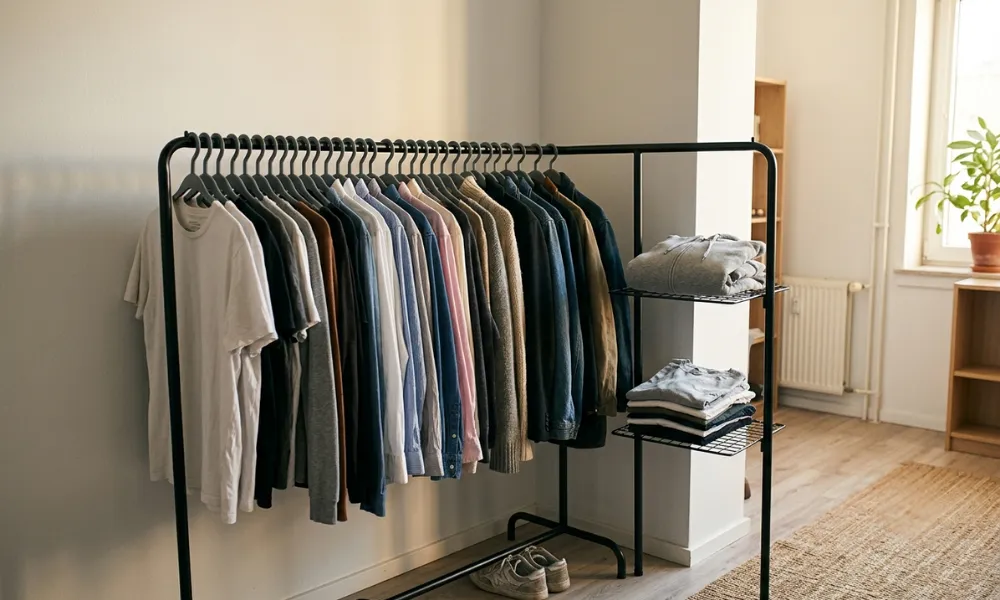
Budget option: Basic metal garment racks are available on Amazon for $25 to $40. That is a one-time purchase that solves your biggest storage problem immediately.
If you want to keep costs at zero, a tension rod fitted between two walls in a corner or alcove creates the same hanging space without buying anything beyond the rod itself, which costs around $8 to $12.
How to make it look intentional and not messy:
- Face all hangers the same direction
- Organize clothes by type: shirts together, pants together, jackets together
- Keep only current-season clothes on the rack, box the rest under the bed
- Hang a simple curtain rod and curtain panel in front of the rack if you want to hide it from view
2. Use Every Inch Under Your Bed
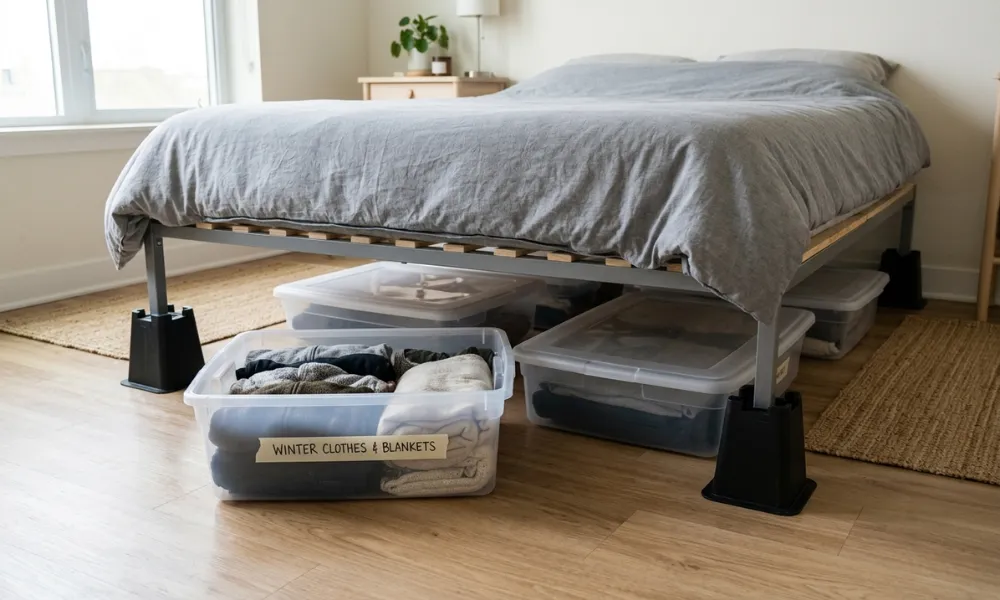
In a studio apartment, the space under your bed is basically a free storage room. If you are not using it, you are wasting some of the most valuable square footage in your apartment.
What to store under the bed:
- Off-season clothing in flat storage bags
- Extra bedding and pillows in zip bags
- Shoes in their boxes or a flat under-bed shoe organizer
- Books, board games, or hobby supplies
- Suitcases and bags (and put things inside those suitcases too)
If your bed sits too low to the ground: Bed risers lift your bed frame 4 to 6 inches in about two minutes. They cost $10 to $15 for a set of four and instantly double your under-bed storage capacity.
Pro Tip: Use flat, lidded bins under the bed rather than random bags. They slide in and out cleanly, keep things dust-free, and you can label them so you actually know what is in there.
3. Go Vertical: Floating Shelves Are Your Best Friend
When floor space is limited, the answer is always to go up.
Floating wall shelves give you storage and display space without taking a single inch of floor space. In a studio with no closet, they become the backbone of your entire organization system. They work just as well in a bedroom — see creating storage with no built-ins for more ideas.
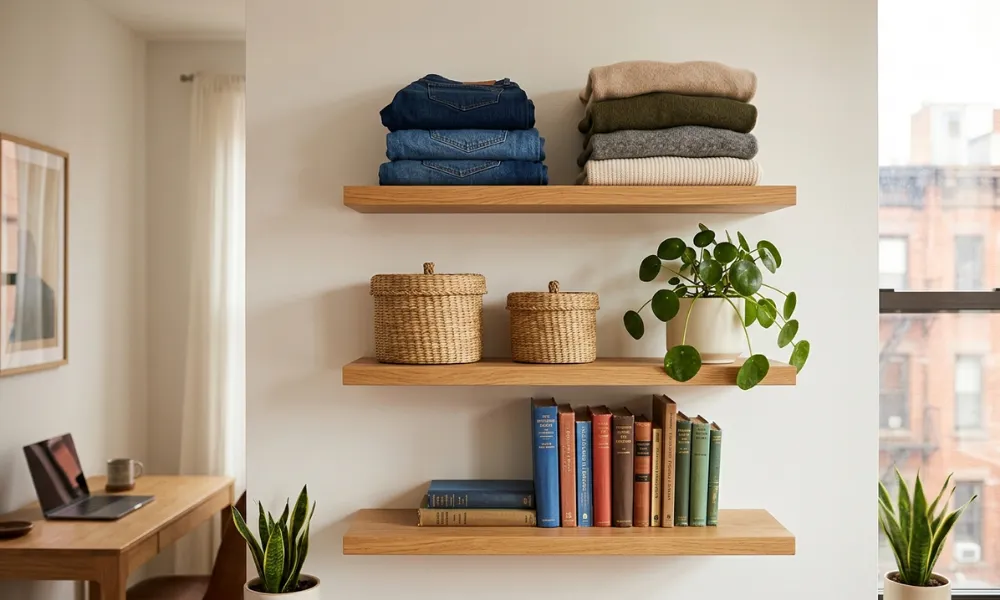
What to store on floating shelves:
- Folded clothes like jeans, sweaters, and t-shirts, stacked neatly
- Books and notebooks
- Small plants or decor items to make the space feel intentional
- Baskets or bins holding smaller items like accessories, chargers, and skincare
Where to install them: Above your desk, above your bed, along a blank wall, or in an awkward corner that is otherwise wasted space.
Budget option: Basic floating shelves from IKEA or Amazon run between $15 and $30 per shelf. You need a drill and two wall anchors, and installation takes about 20 minutes per shelf.
4. Hooks and Command Strips on Every Door and Wall
In a studio apartment, every door is a storage opportunity.
Over-door hooks, adhesive command hooks, and mounted hook rails turn the backs of doors, the sides of cabinets, and bare wall sections into functional hanging storage. No drilling required for most of them.
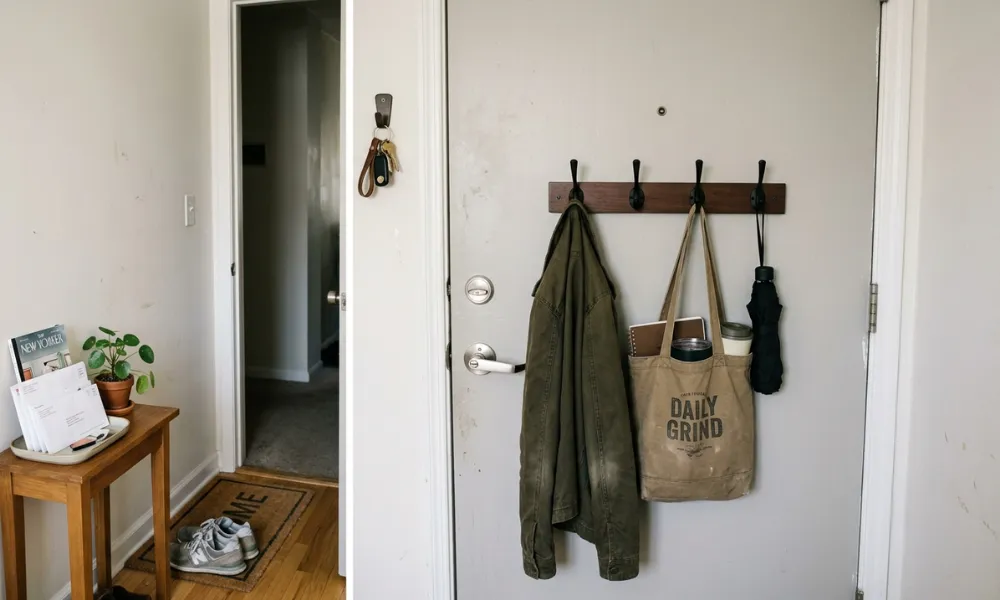
What to hang where:
- Back of the main door: coats, bags, umbrellas, and keys on a hook rail
- Bathroom door: towels, robes, and a small over-door organizer for toiletries
- Inside cabinet doors: cleaning supplies, small tools, or extra toiletries
- Bedroom wall: a row of command hooks for bags, hats, and everyday accessories
A pack of large command hooks costs around $8 to $10 and holds up to 7 to 10 pounds each. For a studio with no closet, this is genuinely one of the highest-value purchases you can make.
Pro Tip: Keep the hooks near the door for things you grab daily. Coats, bags, headphones, and keys should all live within reach of the entrance. When things have a designated spot right at the door, you stop putting them on the nearest chair.
5. Use a Storage Ottoman as Your Coffee Table
In a single-room studio, every furniture piece should do at least two jobs.
A storage ottoman as your coffee table is one of the smartest swaps you can make. It gives you a surface to put things on, seating when guests come over, and a large hidden storage compartment inside for blankets, pillows, gym bags, or anything you want out of sight.
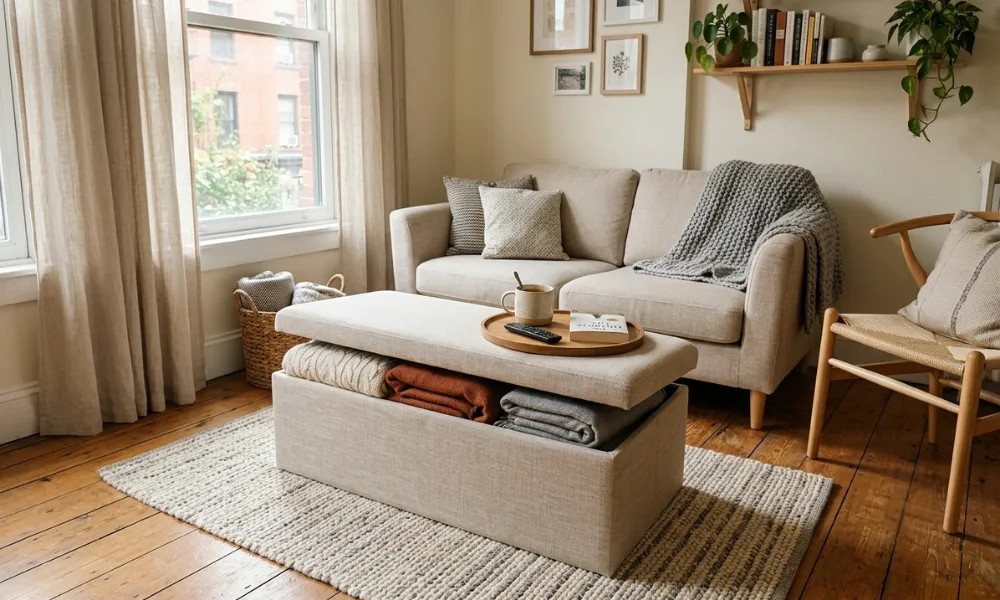
Budget option: Storage ottomans on Amazon range from $35 to $80 depending on size. Compared to a standard coffee table with zero storage, the cost difference is minimal and the benefit is significant.
What to keep inside: Extra throw blankets, pillows for guests, gym gear, board games, anything that is used occasionally but clutters the space when left out.
6. A Bookshelf or Cube Organizer as a Room Divider
This solves two problems at once.
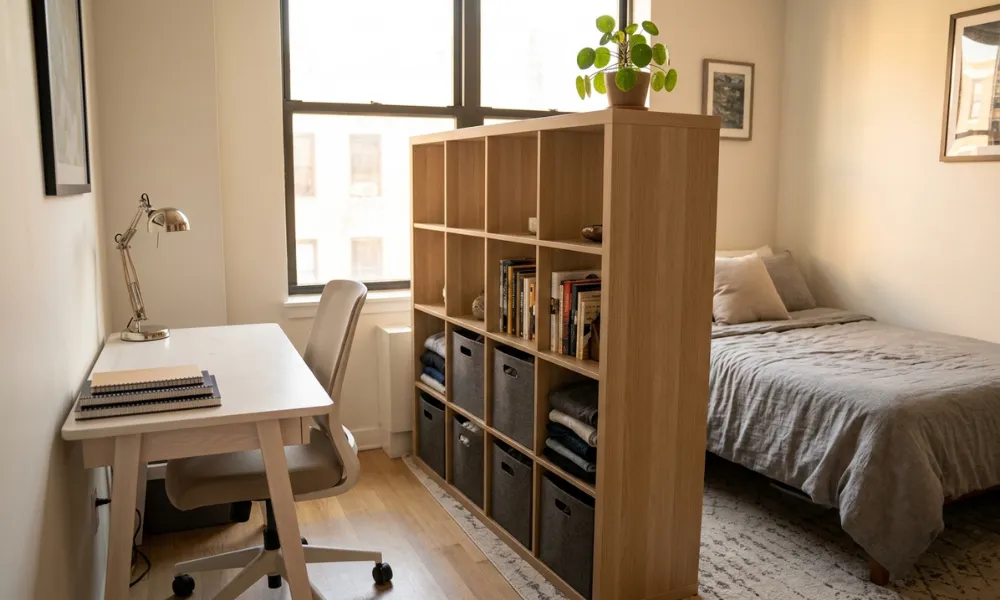
In a studio apartment, your bed, your couch, and your desk are all in the same room. Without any visual separation, the space feels chaotic and it becomes very hard to switch mentally between “work mode” and “relax mode” when everything is in your direct line of sight.
A tall bookshelf or cube organizer placed strategically between your sleeping area and your workspace creates a visual separation that makes both areas feel more intentional. And at the same time, both sides of the shelf are usable storage space.
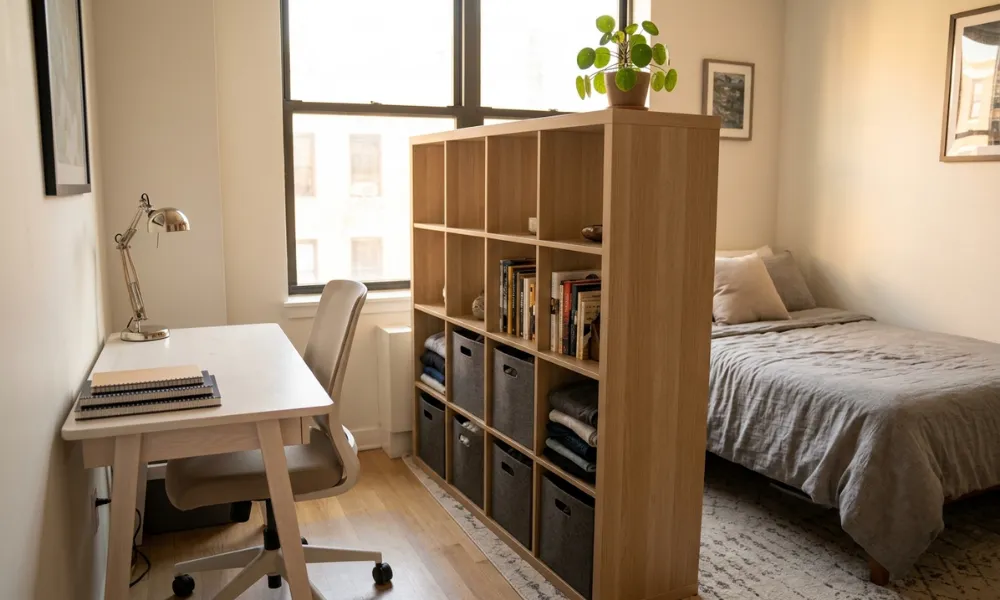
How to set it up:
- Place a 5-shelf bookcase or a 4×2 cube organizer perpendicular to a wall to divide the space
- The desk side holds books, notebooks, and work materials
- The bedroom side holds folded clothes, baskets, and personal items
- Keep the top of the divider clear or with a small plant to keep the space feeling open
Budget option: IKEA’s KALLAX cube organizer (4×2) costs around $70 and is one of the most versatile pieces you can own in a small apartment. It doubles as a room divider, a wardrobe replacement, and a display shelf all at once.
7. Your Suitcases Are Storage Units
Most people store their suitcases empty. That is wasted space.
In a studio apartment, every suitcase you own is a perfectly functional storage bin. Use them to store off-season clothes, extra bedding, formal wear you only need a few times a year, or anything else you need to keep but rarely access.
Stack suitcases in a corner or slide them under the bed if they fit. If you have a hard-case suitcase, you can even use it as a side table with a tray on top.
What to put inside:
- Winter clothes during summer, summer clothes during winter
- Extra bed sheets and towels
- Formal wear in garment bags placed flat inside
- Holiday decorations or seasonal items
Pro Tip: Label the outside of each suitcase with a sticky note or tag so you know what is inside without opening all of them.
8. Pegboard Wall for a Functional, Visual Organization System
A pegboard mounted on one wall gives you the most flexible storage surface you can create. Hooks, shelves, bins, and holders can be rearranged at any time with no additional drilling or holes in the wall.
In a studio where you work and live in the same space, a pegboard on the wall above your desk keeps your workspace organized without cluttering the desk surface itself. Hooks hold headphones, small bags, and cables. Small shelves hold notebooks, a small plant, and a pen holder. Nothing is on the desk that does not need to be there.
Budget option: A 24×48 inch pegboard panel costs around $20 to $30 at Home Depot or online. Basic hooks and accessories add another $10 to $15. Total investment under $50 for a fully functional wall storage system.
9. Separate Your Work Zone and Living Zone (Even If It Is All One Room)
This one is less about physical storage and more about mental organization, but it makes a real difference.
When your studio is also your office, the biggest hidden problem is that you never fully switch off. Your laptop is always visible from your bed. Your work bag is always in the corner. It is very easy to let the whole space become “the room where work happens” and lose the feeling of having a home.
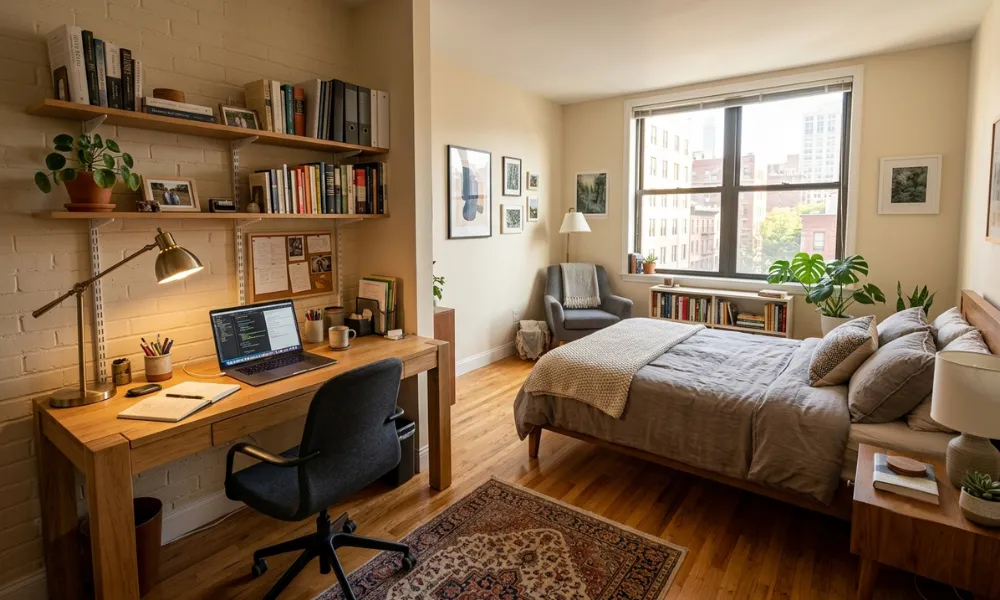
A few simple boundaries change this completely:
- Give your desk a defined zone with its own light, its own shelf, its own area. When you sit there, you are at work. When you leave it, work is behind you.
- Keep your bed space clean of work items. Laptop, chargers, and notebooks should live at the desk, not on the bed.
- Use a small rug to define the living area. Even a basic $20 to $30 rug under a small couch or chair creates a visual “living room zone” that feels separate from the desk area.
This does not require any extra storage. It just requires drawing mental lines that the physical space respects.
10. The “One In, One Out” Rule for a Studio With No Storage Backup
In a house, when you buy something new, you can find somewhere to put it. In a studio with no closet, there is no backup. Every new item you bring in competes directly with the space you already have.
The one in, one out rule is simple: when something new comes into the apartment, something old goes out. New jacket? One old jacket leaves. New set of plates? Old set goes. New book? Donate an old one.
This is not about being minimal for the sake of it. It is about keeping your space functional. A studio gets cluttered fast when things accumulate with nowhere to go, and once it tips into feeling crowded, the motivation to keep it clean drops significantly.
How to start the habit:
- When you unpack a new purchase, immediately identify what it is replacing
- Keep a small donation box in the apartment at all times, when it is full, drop it off
- Do a quick sweep once a month: anything you have not touched in 30 days that is taking up visible space should be evaluated
The Real Cost of a Messy Studio
Here is something worth saying directly.
When your living space is also your workspace, clutter does not just affect how the apartment looks. It affects how you feel, how focused you are, and how productive you can be. Research consistently shows that physical clutter competes for your attention whether you are consciously aware of it or not.
A studio that feels cramped and chaotic is not just an inconvenience. It is a constant low-level drain. You feel tense when you come home. You feel embarrassed when someone visits. You feel unmotivated at your desk because there is visual noise everywhere.
The flip side is also true. Spending two to three hours on a weekend organizing your studio, giving everything a place, and creating some clear empty surfaces, genuinely improves how you feel in the space day to day. You sleep better, you work more effectively, and your home starts feeling like a place you actually want to be.
It does not require a big budget. Most of what is covered in this guide costs very little or nothing. It just requires a few hours of intentional effort.
Frequently Asked Questions
Q: Can I organize a studio apartment with no closet without buying anything? Yes, most of the foundational strategies require no purchases. Using the space under your bed, adding hooks on doors, using suitcases as storage, and separating your work and living zones are all zero-cost moves. The low-budget purchases like bed risers, command hooks, and a garment rack are optional upgrades that make the system work better.
Q: How do I make a studio apartment look less cluttered when I have a lot of stuff? The main thing that makes small spaces feel cluttered is not volume, it is visibility. Getting things off the floor and off surfaces (onto hooks, shelves, inside ottomans) makes an immediate visual difference. Start by clearing every horizontal surface and finding a “home” for each item that is off the floor.
Q: What is the single most useful purchase for a no-closet studio? A freestanding garment rack. It directly replaces the function of a closet rod, costs between $25 and $40, requires no installation, and solves the biggest storage problem in a studio with no closet in about 10 minutes.
Q: How do I organize a studio when I also work from home in it? Define your workspace physically and visually with its own area, light, and storage. Keep work items at the desk and out of the sleeping and relaxing zones. Even in a single room, boundaries between zones dramatically reduce the mental noise of living and working in the same space.
Final Thoughts
A studio apartment with no closet is genuinely challenging. But the problem is almost never that the space is too small. It is that the space has not been set up with intention.
When everything has a designated place, when your clothes have a rack, your under-bed space is used, your walls are working for you, and your work zone is separate from your living zone, the same apartment that felt cramped and chaotic starts to feel manageable. Calm, even.
It takes one weekend. Maybe two to three hours of real effort.
Do it on your next day off. You will feel the difference the same evening.
Which of these ideas are you trying first? Drop it in the comments. And if you do a before and after, share it. There is nothing more motivating than seeing a real result in a real space.




Trackbacks/Pingbacks