
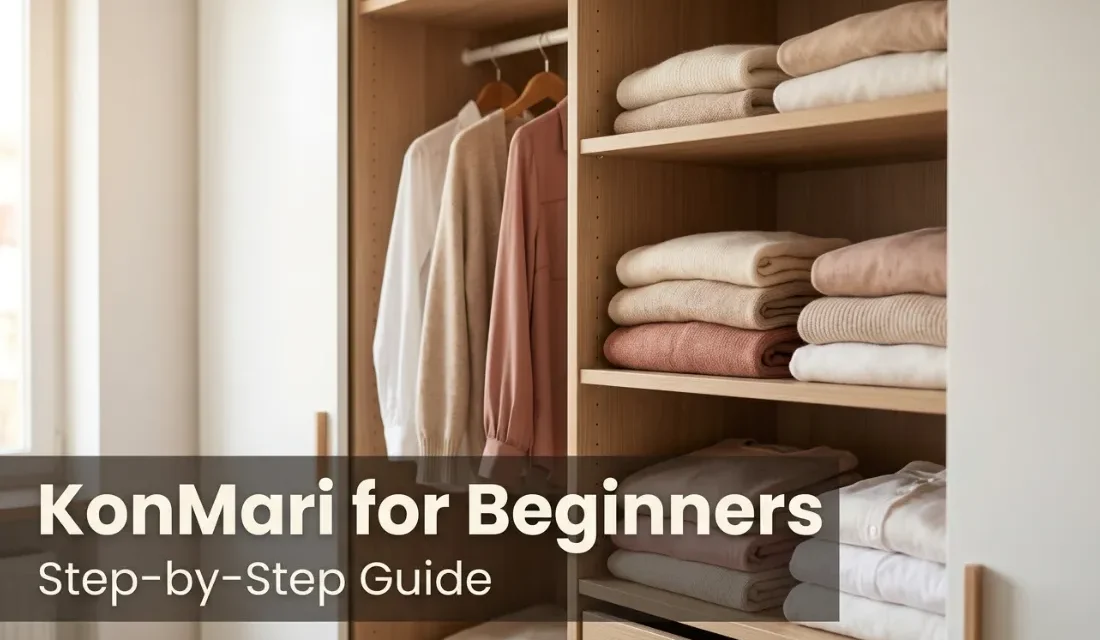
It started, as most rabbit holes do, with one random YouTube video.
I wasn’t even looking for a tidying method. I clicked on something about organizing a small apartment and twenty minutes later I was deep into a clip of Marie Kondo crouching on someone’s floor, holding a sweater with both hands, eyes closed, completely still.
“Does it spark joy?”
I remember thinking: this is either genius or completely ridiculous.
Spoiler: it’s a bit of both. And it works.
If you’ve been curious about the KonMari method but had no idea where to actually begin, this guide is for you. I’m going to walk you through exactly how it works, what order to do it in, what “spark joy” really means in practice, and the mistakes most beginners make before they even get started. Still deciding which method fits you? This decluttering methods comparison puts KonMari side by side with minimalism and slow decluttering.
What Is the KonMari Method, Actually?
The KonMari method is a decluttering and organizing system created by Japanese organizing consultant Marie Kondo. She introduced it in her book The Life-Changing Magic of Tidying Up, and it became a global phenomenon after her Netflix show Tidying Up with Marie Kondo launched in 2019.
The core idea sounds simple: keep only the things that “spark joy,” and let go of everything else.
But the method is more structured than just picking up random items and deciding if you like them. There’s a specific order, a specific process, and a mindset shift that makes the whole thing actually stick long-term.
Here’s what makes it different from regular decluttering:
- You tidy by category, not by room. This is huge. Most people go room by room and wonder why their house still feels cluttered a month later.
- You touch every single item. Not glance at it. Touch it.
- You decide what to KEEP, not what to throw away. The question is never “should I get rid of this?” It’s “does this deserve a place in my life?”
That small flip in thinking changes everything.
The 5 KonMari Categories (In This Order)
Marie Kondo is very specific about the order you tackle categories. This isn’t random. You start with the easiest decisions and work toward the hardest. By the time you get to sentimental items, you’ve already trained yourself to feel the difference between joy and obligation.
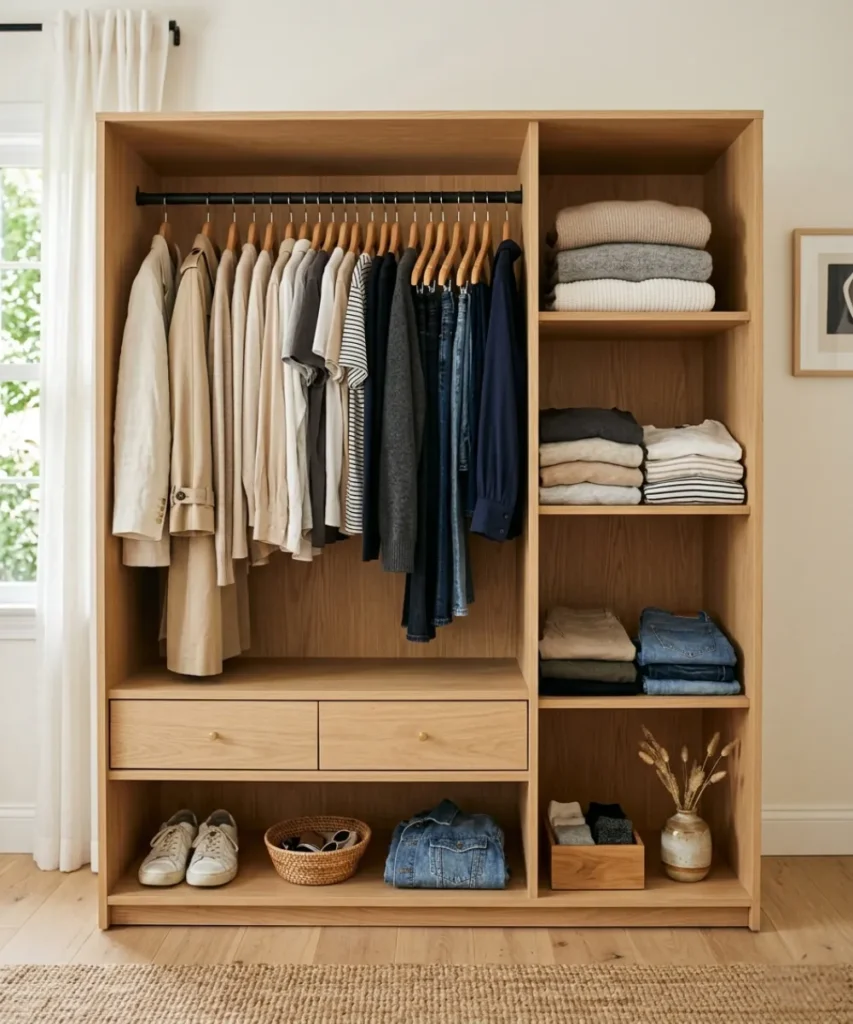
- Clothes
- Books
- Papers
- Komono (miscellaneous items, which includes kitchen)
- Sentimental items
Most beginners want to start with sentimental items because that pile in the corner has been bothering them for years. Resist that urge. Trust the order.
Step 1: Clothes First — Here’s How to Actually Do It
Clothes are the best starting point because most of us have a complicated relationship with them. We keep things that no longer fit, things we bought with good intentions, things we haven’t worn in three years “just in case.”
Here’s the process:
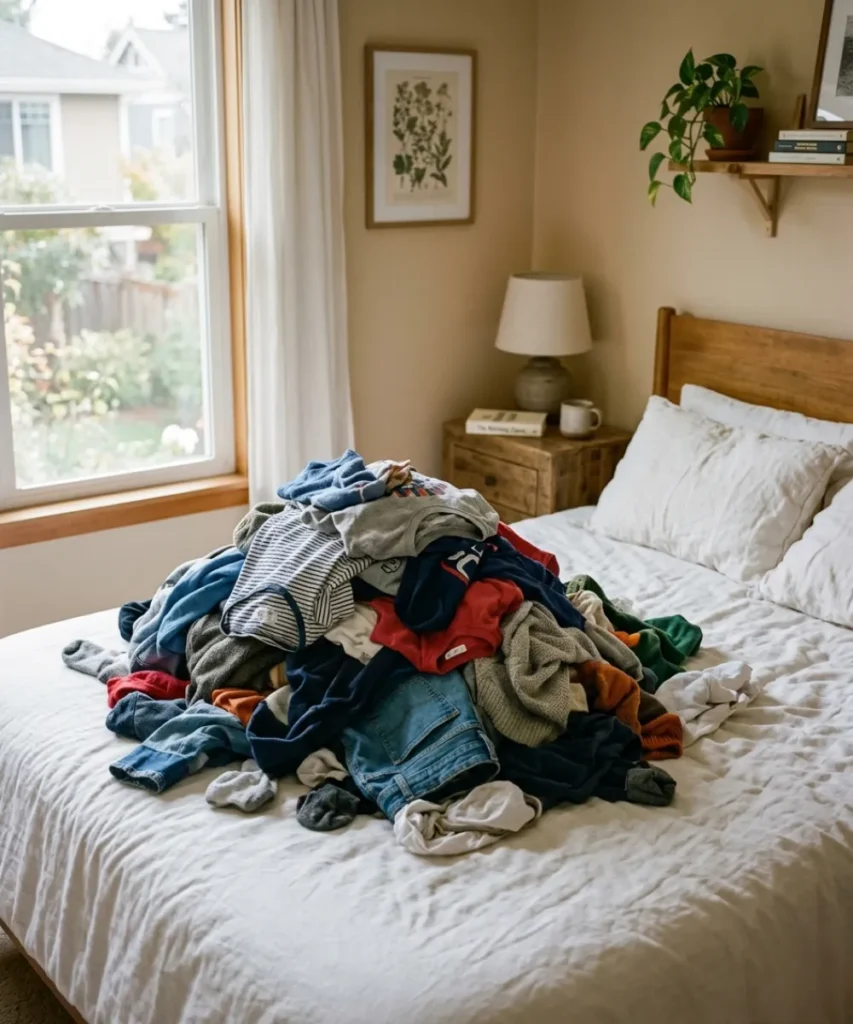
Pull every single piece of clothing out of every location in your home. Wardrobe, drawers, under-bed storage, that one chair in the bedroom where things pile up, the box in the back of the closet. All of it. Put it on your bed or the floor in one big pile.
Yes, it will look terrifying. That’s the point.

Now pick up each item. Hold it. Don’t look at it — feel it.
Does your body respond with something warm? A little lift? That’s joy.
Does it feel heavy, guilty, or like you’re holding it out of duty? That’s not joy. That’s obligation.
The old shirts you haven’t touched since 2021, the jeans that technically fit but make you feel uncomfortable, the sweater your aunt gave you that you’ve never actually liked — these things don’t deserve space in your home or your head.
When I went through my own clothes, the ones that were obviously worn out or no longer my style were easy. The tricky ones were the “what if I need this someday” category. Here’s a reality check: if you haven’t reached for it in over a year and you’re not excited to put it on right now, it’s not serving you.
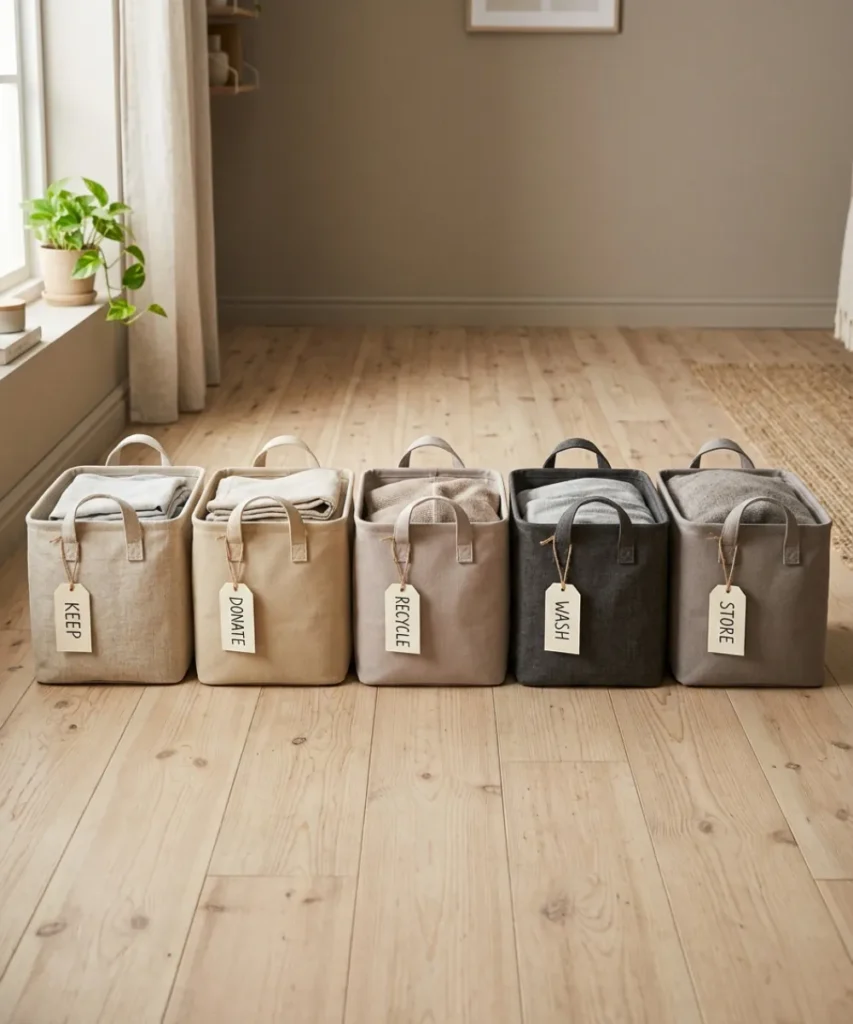
For items you’re letting go of, sort them into:
- Donate (local thrift stores, Goodwill, Salvation Army, Buy Nothing groups)
- Sell (Poshmark, ThredUp, Facebook Marketplace for better pieces)
- Recycle (H&M, Patagonia, and many local councils accept worn textiles)
- Bin (genuinely worn out, torn, stained beyond use)
Step 2: Books
Keep the books that genuinely excite you to reopen. The ones you bought meaning to read, read halfway, or kept because you felt you should want to read them — those can go. Books should feel like possibility, not guilt.
A simple rule: if it doesn’t make your shelf feel alive, it belongs in a Little Free Library or at a charity shop where someone will actually love it.
Step 3: Papers
Papers are brutal because we always think we need them. Go ruthless here. Keep:
- Current financial documents and tax records (last 7 years)
- Active warranties and insurance
- Medical records you actively reference
Everything else: shred or recycle. Most things you think you’ll need are available online anyway.
Step 4: Komono (Including Your Kitchen)
This is the big one for most households, and honestly the most satisfying when you’re done.
Komono covers everything miscellaneous: kitchen items, bathroom, cleaning supplies, hobby items, electronics, decorations, and more.
For the kitchen specifically:
Pull everything out of your cabinets. Everything. Countertop appliances, utensils, the drawer of mystery gadgets, the plastic containers without lids.
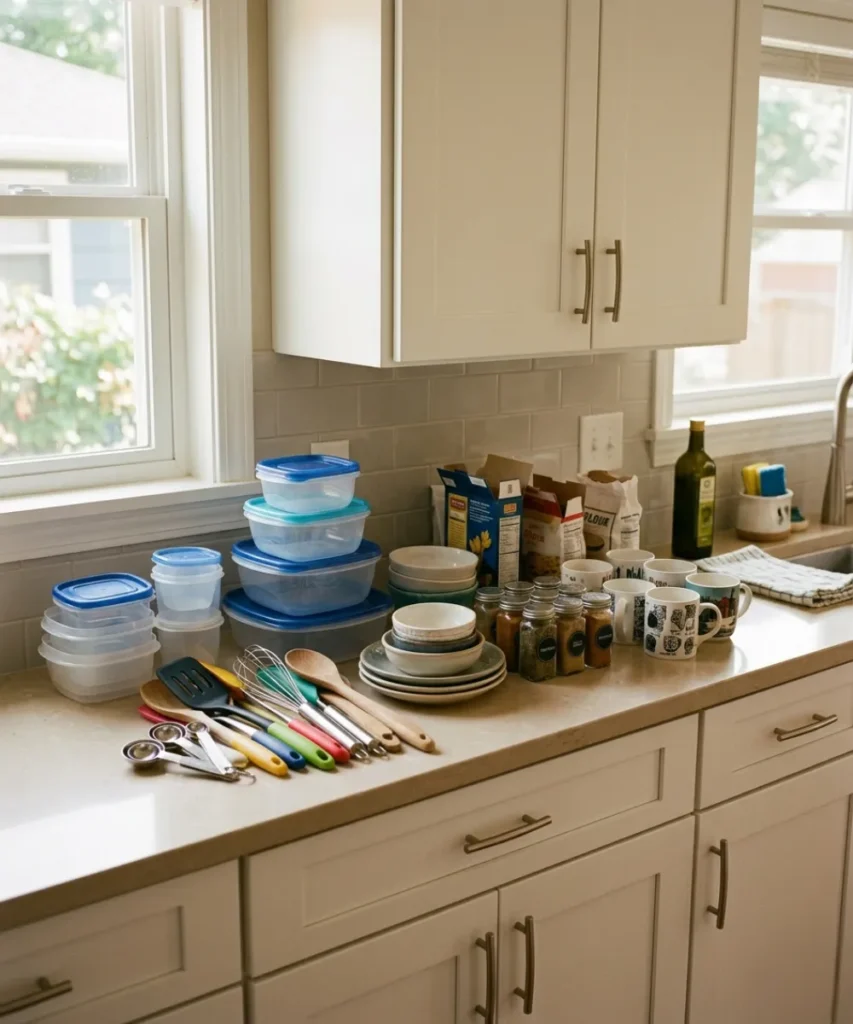
This is where the “spark joy” test gets interesting. A spatula probably doesn’t spark joy in a hearts-and-butterflies way, but does it work well? Is it something you actually use? Does it make cooking easier? That counts as functional joy — it earns its place.
What doesn’t earn its place:
- Duplicate items — three spatulas, seven mismatched lids, four can openers
- Old plastic containers that are warped, stained, or missing lids (these are not coming back to health)
- “Aspirational” appliances you bought thinking you’d use (the pasta maker you’ve opened twice, the bread machine from 2018)
- Freebie items that found their way in and never left — branded mugs, promotional freebies, plastic bags stuffed inside other plastic bags
When I went through my own kitchen, the biggest “aha” was the plastic containers situation. An entire shelf was dedicated to mismatched lids and stained containers I kept convincing myself I’d use “for leftovers.” Out they went. What replaced them: four matching glass containers I actually enjoy using.
For decorations:
This is where the “spark joy” rule is at its purest. Decoration has no functional excuse. If it’s sitting on a shelf and you don’t feel anything when you look at it, it’s just collecting dust.
Keep the piece that makes you smile when you walk past it. Let the rest find a new home.
Step 5: Sentimental Items
Leave these for last, when your joy-sensing muscles are trained.
Old photos, gifts from people you love, childhood things, handwritten letters. These are genuinely hard. Give yourself time with them.
A helpful reframe: keeping every single item from someone doesn’t honor them more. Choosing the things that genuinely carry meaning, and letting go of the rest with gratitude, is actually a deeper form of respect.
What “Spark Joy” Actually Means (Because It Confuses a Lot of People)
The phrase gets mocked online but the concept is real and practical.
Spark joy doesn’t mean everything in your home should give you butterflies. It means: does this item earn its place? Does it serve you, make you happy, or do something useful in your life?
A toilet brush does not spark joy. But a toilet brush that works well and lives tidily in a clean bathroom? That contributes to a home that sparks joy overall.
The question is really: “Does keeping this make my life better, or does it just take up space and add visual noise?”

Common Mistakes Beginners Make
Starting with the sentimental pile. You’ll get emotional and exhausted before you’ve built any decision-making momentum. Trust the order.
Organizing before decluttering. Buying storage baskets before you’ve decided what you’re keeping is one of the most common mistakes. You’ll just end up with nicely organized clutter. Declutter first. Organize second.
Doing it room by room instead of category by category. Your clothes live in three different rooms. Your papers are in four different drawers. Category-based sorting forces you to see the full picture of how much you actually own.
Involving other people’s stuff without permission. Do your own things first. Watching you do it often naturally motivates people around you. Touching someone else’s belongings without asking is a great way to start an argument.
Expecting it to be done in a weekend. KonMari is a process, not a one-afternoon project. A realistic timeline for a full home is several weekends. That’s normal.
What to Do With Everything You’re Getting Rid Of
This is where a lot of people get stuck. They declutter a pile and then it sits in bags by the front door for three weeks.
Make a same-day plan before you even start:
- Clothes and household items: Goodwill, Salvation Army, local Buy Nothing Facebook groups, ThredUp (mail-in), Poshmark (sell)
- Books: local library, Little Free Library, ThriftBooks trade-in
- Kitchen items: Goodwill, Facebook Marketplace for higher-value items
- Broken electronics: Best Buy take-back program, local e-waste drives
- Old wood, broken furniture: if you have a yard, a small autumn bonfire is a genuinely satisfying way to close the decluttering chapter. There’s something about the whole ritual that works — a clear evening, a fire, watching the old stuff actually go. Some people call it a “declutter and bonfire” night, and honestly it turns a chore into something almost ceremonial.
- Papers: shred sensitive documents, recycle the rest
Having a donation run scheduled for the same day or the day after keeps the momentum going and stops the bags from becoming permanent fixtures.
Your KonMari Starting Checklist
Here’s what to do before you begin:
- Pick one category to start (clothes, always clothes)
- Clear a large floor or bed space
- Have bags or boxes ready for donate, sell, recycle, bin
- Schedule a donation drop-off before you begin
- Tell yourself this will take a few sessions, not one day
- Put on music or a podcast — this should feel good, not punishing
FAQ
How long does the KonMari process take for a whole home? Marie Kondo says most people complete the full process in about six months if they’re doing it properly. Realistically, a focused weekend per category is a good pace. Don’t rush it.
Do I have to do every category? You don’t have to follow the method perfectly to benefit from it. Most people start with clothes and kitchen and see dramatic results just from those two. But doing all five categories gives you a home-wide reset that sticks.
What if my family members don’t want to declutter? Only work on your own belongings. Shared spaces are a conversation, not a unilateral decision. Leading by example is genuinely more effective than trying to convince anyone.
Is the KonMari method good for renters? Absolutely. In many ways it’s better suited for renters because you’re working with less space and need everything you keep to earn its place. You’re also not constrained by built-in storage you can’t change.
What if I get rid of something and regret it? It happens occasionally but far less often than people expect. Most things you second-guess in the moment you forget about completely within a week. If it happens, you can often find the item secondhand for very little.
Can I do KonMari on a small apartment? Yes, and it’s especially effective in small spaces. With less square footage, every item counts more, and the relief after decluttering is immediate and very visible.
Final Thought
The KonMari method isn’t about having a minimalist home from a design magazine. It’s about knowing exactly what’s in your home, knowing everything there has a reason to be there, and not spending mental energy navigating clutter every single day.
It starts with one pile of clothes on a bed. It ends with a home that actually feels like yours.
Start this weekend. Just the clothes. That’s enough.
Related Articles:
- 10 Storage Solutions Using Items You Already Own
- How to Organize a Studio Apartment With No Closet Space
- The Best Way to Declutter Before a Move (Coming Soon)
- How to Fold Clothes the KonMari Way (Coming Soon)



Trackbacks/Pingbacks