
For two years, my laundry “room” was a closet so narrow I had to stand sideways to pull clothes out of the dryer. The detergent lived on top of the dryer, where it fell off at least once a week. There was nowhere to fold anything, so clean laundry traveled to my bed, sat there in a basket for three days, and half of it got worn straight out of the basket without ever being put away. I am not proud of this system. But I am telling you about it because if your laundry setup looks anything like that, the nine ideas below genuinely changed how my laundry days feel.
What Actually Makes a Tiny Laundry Room Work
A small laundry room does not fail because it is small. It fails because every inch is doing nothing on purpose. In a big laundry room you can get away with vague zones and good intentions. In a closet-sized one, every surface has to earn its place, and the workflow — sort, wash, dry, fold — needs a defined spot for each step, even if that spot is twelve inches wide.
The three principles behind every idea below: go vertical (walls are free real estate), use the doors and gaps (the spaces you walk past), and make things disappear when you are done (fold-down beats permanent in tight quarters). Before I bought a single basket, I ran a 12-12-12 round on the laundry closet — twelve things to toss, twelve to donate, twelve to put back. You cannot organize what you have not decluttered first.
9 Ideas That Work in Tight Spaces
1. Stack the washer and dryer
This is the single biggest footprint win available. A side-by-side washer and dryer eats roughly twice the floor space of a stacked pair, and in a closet laundry that difference is everything. Standard stackable units run about 27 inches wide and 74 to 80 inches tall once stacked; compact 24-inch models exist for genuinely tiny closets. Measure your space first — width, height, and depth — and leave about an inch on each side plus a few inches behind for hoses and vibration.
You will need a stacking kit made for your specific machines (not a universal one — the brackets are model-specific), and if the dryer controls end up uncomfortably high, that is the honest tradeoff. For most people, halving the footprint is worth reaching a little. One more thing worth knowing: front-load washers, which is what stackable units are, generally use less water and energy than top-loaders — ENERGY STAR’s laundry guide has the details if you are comparing models.
2. Put a countertop over front-loading machines
If your machines sit side by side, a simple countertop across the top instantly creates the folding surface you do not have. It does not need to be fancy — a cut piece of butcher block, plywood sealed against moisture, or even a sturdy melamine shelf board works. Mine is a $40 piece of sealed plywood and it has survived three years of hot dryer air.
This one change ended the clean-laundry-on-the-bed era in my house. Wet clothes come out of the washer, go straight into the dryer, and come out onto the counter to be folded on the spot. The whole cycle finally happens in one room instead of migrating through the house.
3. Run open shelving from counter to ceiling
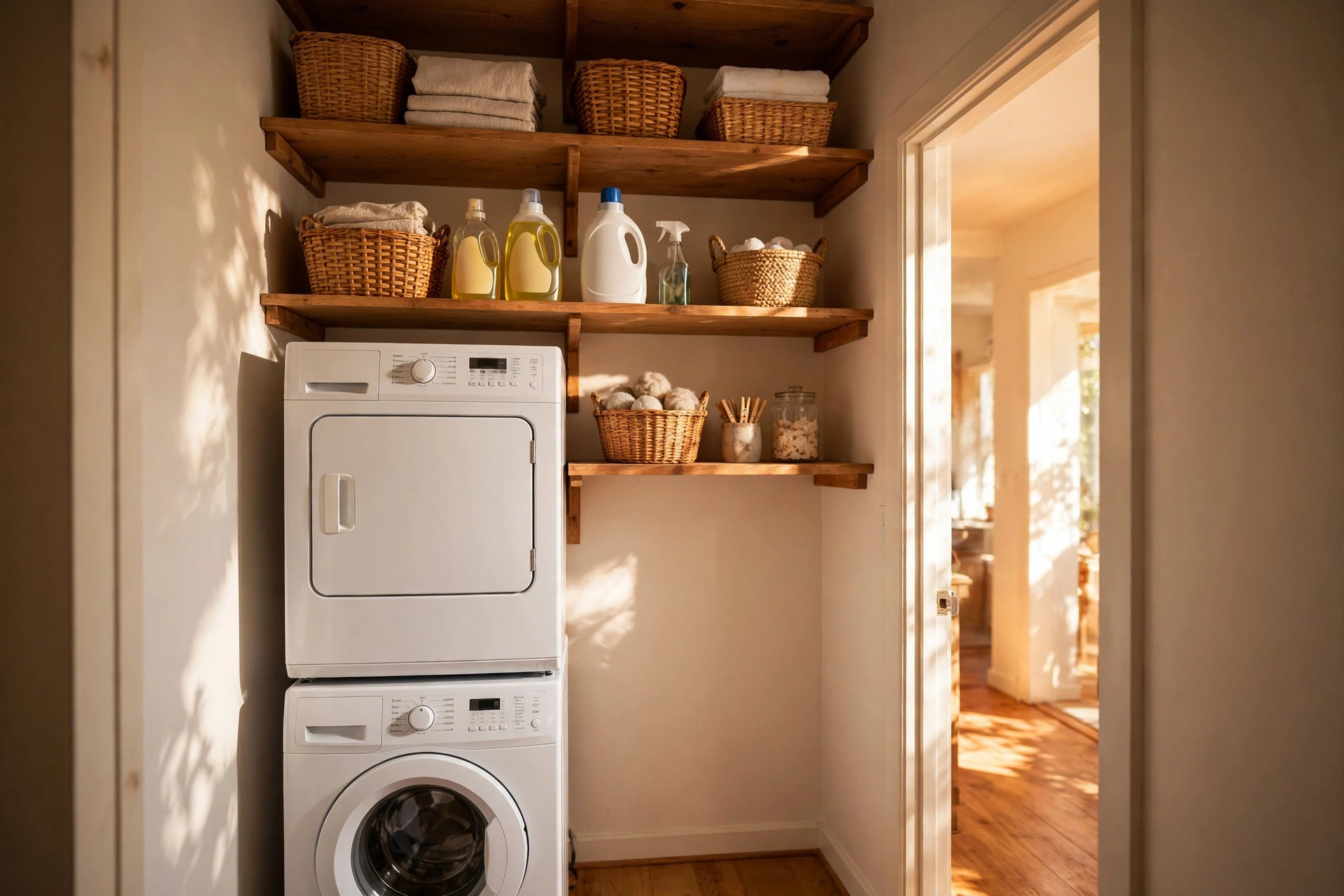
The wall above your machines is the most underused square footage in a small laundry room. Install two or three open shelves from counter height up toward the ceiling. Keep daily items — detergent, stain remover, dryer sheets — at eye level where you grab them without thinking, and push lesser-used things (spare baskets, seasonal supplies) to the top shelf.
Use matching baskets or bins on the shelves rather than letting bottles multiply into visual chaos. And here is the rule that keeps it working: the one-in-one-out rule. Every new bottle that comes in means one empty goes out. Laundry supplies reproduce quietly if you let them.
4. Use the back of the door
The back of the laundry room or closet door is prime storage that costs zero floor space. An over-the-door organizer with clear pockets holds stain sticks, lint rollers, dryer sheets, clothespins, and all the small things that otherwise colonize the countertop. Clear pockets matter — if you cannot see it, you will buy a duplicate.
If you are even slightly handy, Family Handyman’s small-space storage guide shows how to build shallow shelves that mount behind the door, plus a shelf-and-rod combo that gives you hanging space above the machines. The back of the door is one of those wasted spaces most homes are not using for storage — reclaiming it feels like finding a free cabinet.
5. Slide a slim rolling cart into the gap
Almost every laundry setup has a dead gap — between the washer and the wall, or between the two machines — usually six to eight inches wide. A slim rolling cart on wheels slides exactly into that gap and holds detergent bottles, softener, and cleaning sprays upright. Pull it out when you need something, push it back when you do not.
Measure the gap before buying, because these carts come in specific widths and a cart that is half an inch too wide is useless. This is the cheapest idea on this list and somehow the one guests always ask about.
6. Mount a fold-down drying rack
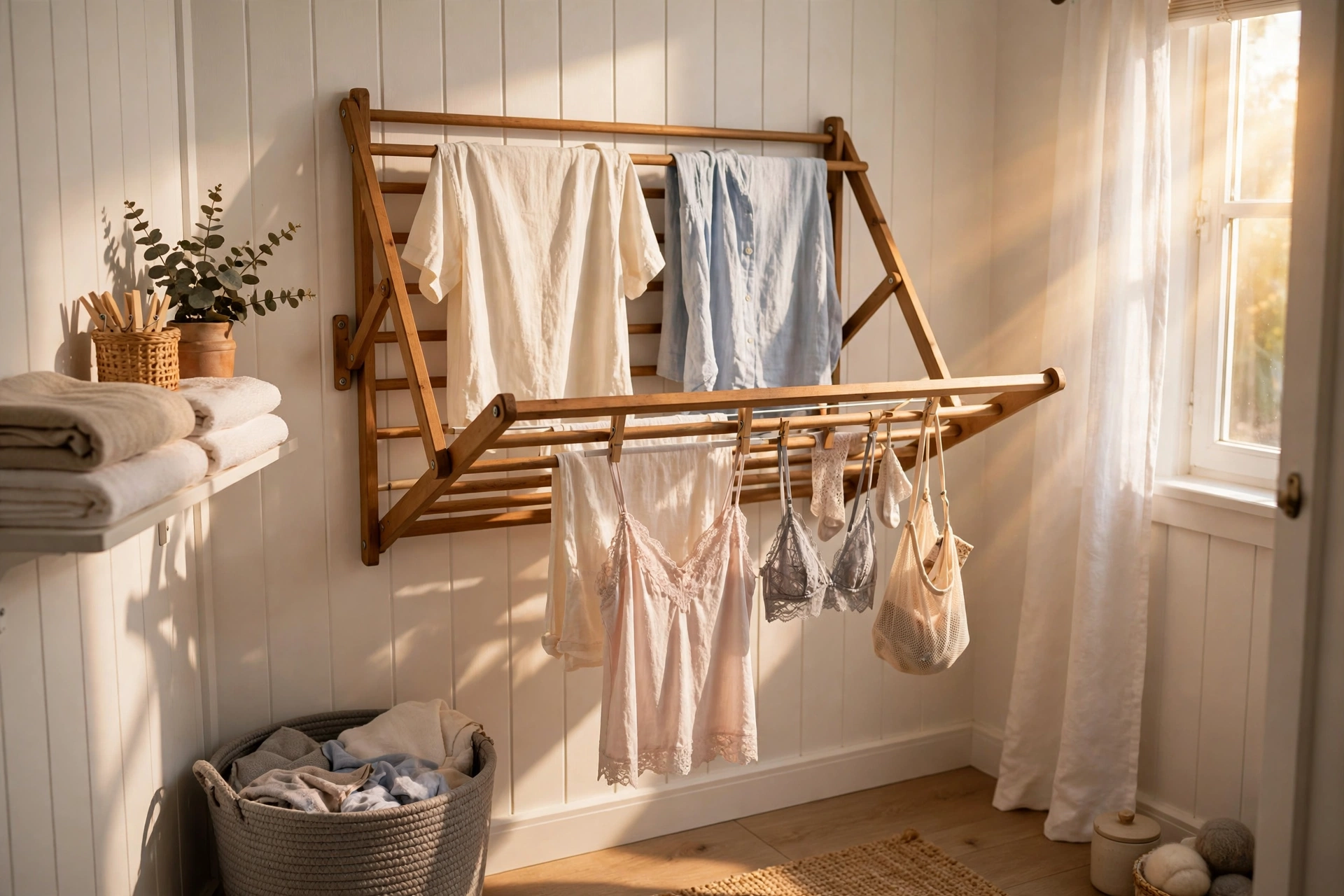
Delicates, wool sweaters, and anything that should not see the dryer need somewhere to air-dry, and a full-size drying rack on the floor of a tiny laundry room is a non-starter. A wall-mounted rack that folds flat against the wall when not in use solves it completely. Pull it down on wash day, fold it back up after.
If you cannot mount anything (renters, I see you), a retractable clothesline that stretches across the room and retracts into a small housing does the same job with zero permanent holes. Either way, the principle holds: in a tight space, drying equipment should disappear when the job is done.
7. Sort with pull-out hampers or labeled bins
Sorting laundry at the machine, in the moment, beats sorting a mountain on the weekend. A set of slim pull-out hampers — or just three labeled bins stacked vertically — gives you whites, darks, and delicates as separate streams from the start. When a bin is full, that is your signal to run the load. No decisions, no piles on the floor.
Label the bins. It sounds fussy, but labels are what keep a shared household actually using the system instead of defaulting back to one giant mixed hamper. A label maker or even masking tape and a marker does the job.
8. Stick magnetic storage on the machines
Washers and dryers are big metal boxes, which means their sides are free magnetic real estate. Small magnetic tins or a magnetic shelf on the side of the machine holds clothespins, stain-remover pens, spare buttons, and the dryer lint brush — all within arm’s reach of where you actually use them.
I keep laundry pods in a repurposed glass jar on a magnetic shelf, which cost me nothing and looks better than the original plastic tub. If you like the repurpose-instead-of-buy approach, my free storage ideas post has a whole system for it.
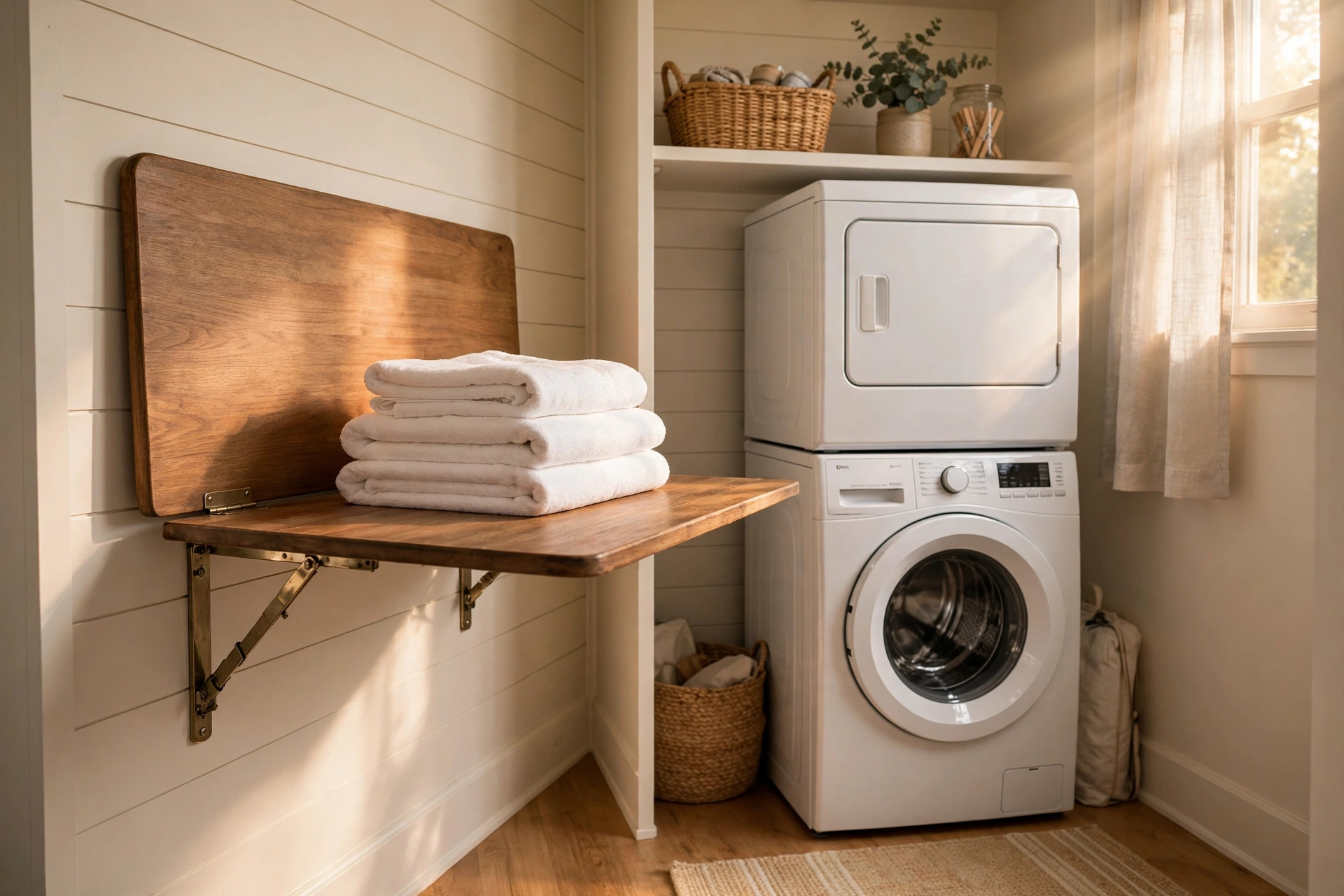
9. Add a folding surface that disappears
If you have no room for a permanent counter, a wall-mounted drop-leaf table gives you a full folding surface on demand and folds flat against the wall when you are done. It needs solid wall anchoring — find a stud, do not trust drywall anchors alone for something you will lean on.
A wall-mounted ironing board works on the same principle and is even slimmer. Honestly, in a tiny laundry room, anything that folds away beats anything permanent. The room should feel like a room when you walk in, not like a storage unit you happen to wash clothes in.
What I Would Do First (My Priority Order)
If I were starting over in that sideways-shuffle closet, here is the order I would do things. First, declutter — nothing else works on top of clutter. Second, stack the machines if they are not already stacked, because footprint is destiny in a small room. Third, the countertop or drop-leaf table, because a folding surface changes the entire workflow. Fourth, shelves and the door organizer, because supplies need homes. Everything else — the cart, the magnetic tins, the drying rack — can come one at a time as budget allows. You do not need all nine ideas. Three done well beats nine done halfway.
Frequently Asked Questions
Can you put a stackable washer and dryer in a closet?
Yes, as long as the closet fits the units plus clearances — roughly 27 inches wide (24 for compact models), 74 to 80 inches tall, and 30-plus inches deep, with about an inch of side clearance and a few inches behind for hoses. Ventilation matters more in a closet: a louvered door or a small exhaust fan prevents moisture buildup, and a ventless dryer is worth considering if running a new vent is impractical.
How do I add a folding surface with no counter space?
A wall-mounted drop-leaf table is the best answer — full folding surface when down, flat against the wall when up. If even that is too much, a sturdy board laid across the top of front-loading machines works as a temporary surface, or fold straight out of the dryer onto a nearby bed or table.
Where do I put the ironing board in a tiny laundry room?
Wall-mount it. A wall-mounted ironing board folds up into a slim cabinet barely deeper than the board itself. Over-the-door hanging holders also work and cost very little. A full-size freestanding board has no business living in a small laundry room.
Are ventless dryers good for small spaces?
They solve the biggest installation headache — no exterior vent to run — which makes them popular for apartments and closets. The tradeoff is longer dry times and more heat and humidity in the room, so plan for ventilation. They pair well with compact stackable washers in genuinely tight footprints.
How do I keep a small laundry room from smelling musty?
Three habits: leave the washer door and the room door ajar between loads so air circulates, wipe the washer’s rubber gasket regularly (that is where the mildew hides), and run a hot empty cycle with vinegar monthly. In a closet setup, a louvered door or a small fan makes a bigger difference than any scented product.
Conclusion
My laundry closet is still small. It will always be small — the walls are not moving. But it finally works: everything has a place, the folding happens in the room instead of on my bed, and I no longer lose the detergent behind the dryer. That is all any of these nine ideas are really about — making a tiny room behave like it was designed on purpose. Pick the two or three that fit your space, start with decluttering, and give it one weekend. Your future laundry days will thank you.