
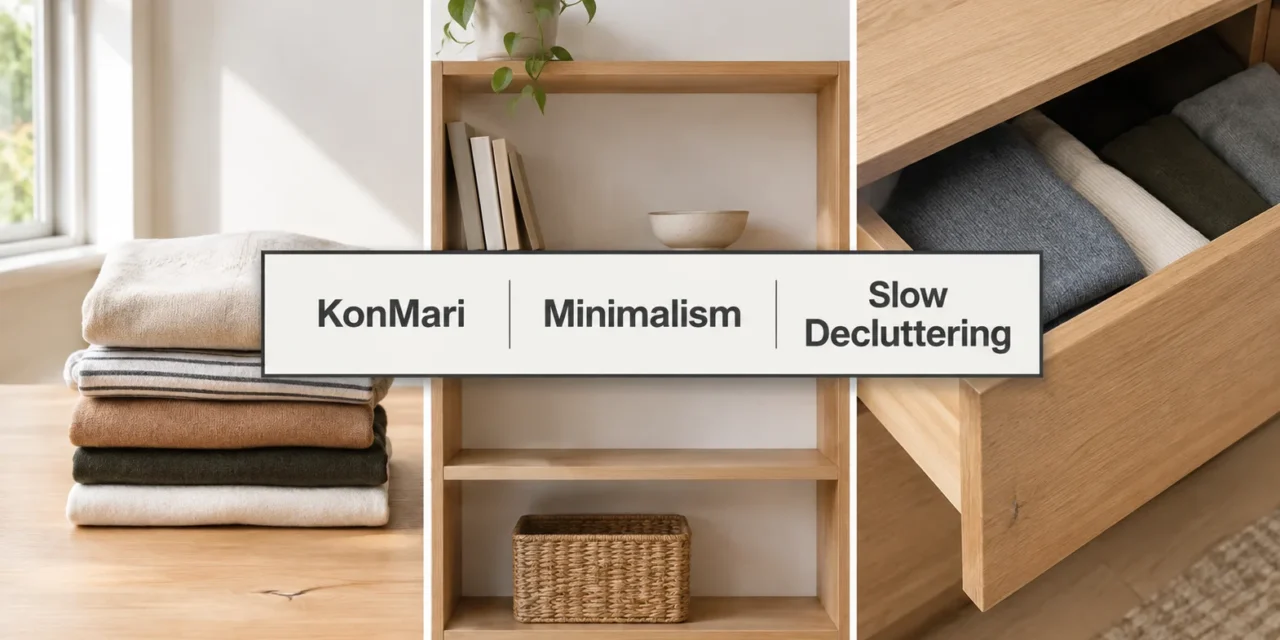
KonMari, minimalism, and slow decluttering all aim for the same result, a home with less clutter, but they get there in three completely different ways, and picking the wrong one for your personality is usually why a decluttering attempt falls apart by week two.
What Actually Makes These Three Methods Different?
KonMari is a specific tidying method with clear rules. Minimalism is a broader lifestyle philosophy about owning less overall. Slow decluttering is a pace, not a philosophy, and it can technically be applied to either of the other two.
The real difference that matters when you are choosing between them is not the end result, since all three lead to a tidier home. It is how much time, emotional energy, and structure each one asks of you upfront.
What Is the KonMari Method?
The KonMari Method, created by Marie Kondo, asks you to declutter by category rather than by room, moving through clothes, books, papers, miscellaneous items, and sentimental items in that specific order. For each item, you ask whether it sparks joy, a physical response Kondo describes as a genuine feeling of happiness or a little lift in your body when you hold it, according to her own explanation of the concept in an interview.
The method is designed to be done in one concentrated push rather than spread out, which is exactly why it works so well for people who want a dramatic before and after. I tried the clothes category on a single Saturday and it took nearly six hours, since every single item, including socks, gets pulled out and evaluated one at a time.
What nobody warns you about is decision fatigue. By hour four I was keeping things just to stop deciding, which defeats the entire point. If you want the full category-by-category breakdown before attempting it yourself, KonMari Method for Beginners: How to Actually Do It walks through each category in the order Kondo recommends.

What Is Minimalism?
Minimalism is not a tidying method at all, it is a lifestyle approach focused on owning fewer things overall so that what remains gets more attention, space, and purpose. Joshua Fields Millburn and Ryan Nicodemus, who run The Minimalists, describe it less as deprivation and more as removing the excess that gets in the way of what actually matters to a person.
Unlike KonMari, minimalism has no official checklist or category order. It is closer to an ongoing filter you apply every time something new comes into your home, asking whether it earns its place rather than whether it sparks a feeling in the moment.
I started my own minimalist shift by setting a rule that nothing new comes in unless something else leaves, which is really just the one-in-one-out rule applied as a daily habit rather than a one-time clean-out. It took about four months before my closet actually felt different, which is much slower than KonMari but far less exhausting week to week.
For anyone drawn to the more extreme end of minimalism, where you also think through what happens to your belongings long term, Swedish Death Cleaning: What It Is and Why It Works covers a related but distinct philosophy worth reading before you commit to one lane.
What Is Slow Decluttering?
Slow decluttering is exactly what it sounds like, tackling one small area at a time instead of overhauling an entire home in a single weekend. Professional organizer Di Ter Avest describes it as a gentle reset rather than a massive purge, going at your own pace and giving yourself room to make decisions without pressure, as explained in this breakdown of the slow decluttering technique.
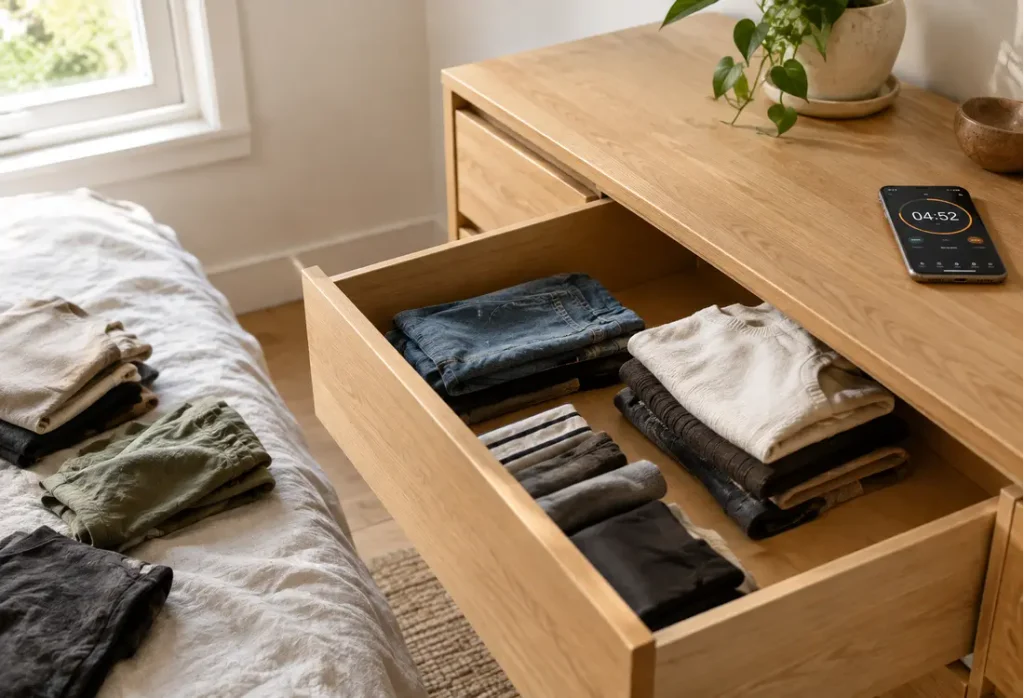
This is the approach I default to now, mostly because I do not have a free Saturday to dedicate to KonMari style sorting with two kids in the house. I pick one drawer on a Tuesday night after dinner, spend fifteen minutes on it, and stop, even if it is not perfect.
The tradeoff is obvious. There is no dramatic before and after photo after one evening, and it can take months to work through an entire home this way. But for anyone who has started and abandoned a big decluttering weekend before, this is the version that actually gets finished, since How to Stop Re-Cluttering After a Big Clean-Out covers why fast, high-intensity clean-outs often do not stick.
Side-by-Side Comparison
| Criteria | KonMari | Minimalism | Slow Decluttering |
|---|---|---|---|
| Time commitment | High, all at once | Ongoing, low per day | Low, spread over months |
| Emotional intensity | High | Medium | Low |
| Speed of visible results | Fast | Slow | Slowest |
| Best for | Free weekends, decisive people | Long-term lifestyle change | Busy schedules, easily overwhelmed |
| Maintenance needed after | Moderate | Built into daily habits | Ongoing, same slow pace |
Which Method Actually Fits Your Situation?
If you have a free weekend, feel decisive rather than sentimental about your belongings, and want a dramatic result fast, KonMari fits best. If you are more interested in changing how much you buy and keep long term, minimalism is less about the cleanup and more about the lifestyle shift.
If your schedule is unpredictable, you get overwhelmed by big projects, or you have tried a big clean-out before and watched the clutter creep back within a month, slow decluttering is the one that actually gets finished. If you want to start even smaller, the 12-12-12 decluttering challenge is a simpler entry-level method. None of these are permanent choices either. A lot of people start with slow decluttering to build momentum, then use KonMari-style category sorting once they hit a specific area like clothes or books.
Frequently Asked Questions
Can I combine KonMari and slow decluttering?
Yes, you can apply the KonMari category order and spark joy question while only tackling one category at a slow, spread-out pace instead of all at once.
Is minimalism the same as decluttering?
No, decluttering is a one-time or repeated task, while minimalism is an ongoing lifestyle approach to what you bring into your home in the first place.
Which method works best for renters?
Slow decluttering tends to work best for renters since it requires no special storage purchases and adapts to whatever space you already have.
How long does slow decluttering take to finish a whole home?
It varies widely, but most people report three to six months working in short sessions a few times a week.
Do I have to pick just one method forever?
No, many people switch methods depending on the season of life they are in, using a faster method during a move and a slower one during a busy work period.






Trackbacks/Pingbacks